
1. The Price of Innovation in the Digital Age
The trajectory of an Indian deep-tech startup is an arduous marathon of engineering resilience and capital-intensive research. For companies like PUR Energy Limited—born out of the Technology Incubation Center at IIT Hyderabad—years are spent perfecting indigenous "clean technologies" to compete on a global stage. Yet, in our hyper-connected era, this hard-earned brand equity is increasingly vulnerable to "digital hit jobs."
The recent judgment in PUR Energy Private Limited vs. M. Prabhakar Aditya (O.S. No. 78 of 2024) marks a watershed moment for the Indian startup ecosystem. It represents a decisive judicial stand against the weaponization of social media for extortion and the deliberate devaluation of legitimate innovation. This case not merely as a corporate victory, but as a critical safeguard for the "Make in India" movement, ensuring that the fruits of indigenous R&D are not pillaged by bad-faith actors seeking viral clout, the ones like Mr Aditya Prabhakar (known as "EV TraxelXP"), resident of Ongole, Andhra Pradesh.
2. Your Reputation is a Fundamental Right
In a sophisticated analysis of modern tort law, the III Additional District and Sessions Judge at Sangareddy emphasized that a brand’s reputation is a strategic asset protected under the Constitution of India. The Court recognized that the defendant’s, Mr Aditya Prabhakar (known as "EV TraxelXP"), campaign was not a legitimate consumer critique but a calculated violation of a fundamental right. Reputation, in the eyes of the law, is as tangible and protectable as physical property.
"The reputation is a sort of right to enjoy the good opinion of others... is protected by the constitution equally with the right to the enjoyment of life, liberty and property."
The judgment underscores that for a Tier-1 startup, reputational risk mitigation is a constitutional entitlement. By launching a "malafide" campaign designed to tarnish the PURE EV brand, the defendant committed a direct assault on the plaintiff’s right to conduct business in a fair and dignified environment.
3. The "POOR EV" Gambit: Why Trademark Infringement Isn’t a Joke
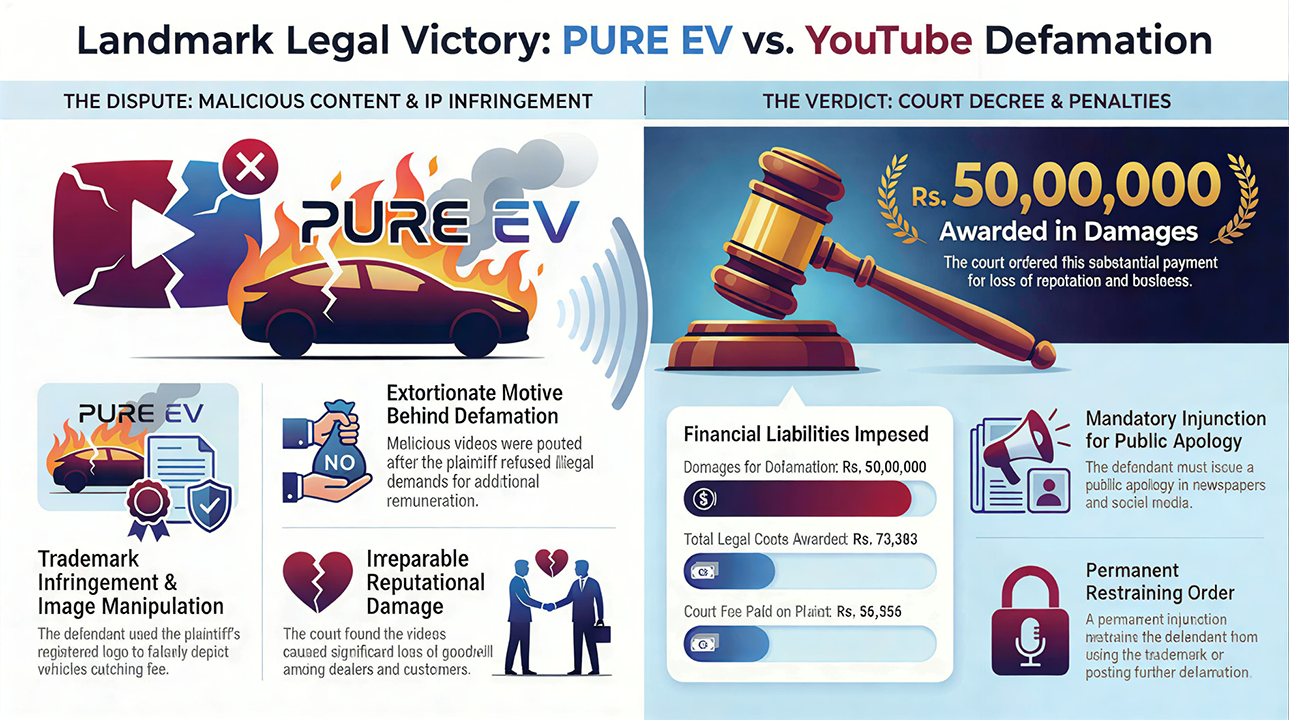
A particularly egregious element of this case was the defendant’s "shrewd" attempt to dilute the PURE EV trademark while attempting to mask his liability. By rebranding his target as "POOR EV" in his video titled "One Company Destroyed the EV Industry| Poor EV| Real Face," the defendant, Mr Aditya Prabhakar (known as "EV TraxelXP"), engaged in a classic tactic of trademark dilution.
The Court found this to be a deliberate manipulation of the brand’s registered identity. The malice went deeper than a mere name change; the defendant engaged in deceptive content creation by morphing images and—most critically—pasting the PURE EV logo onto competition OEMs' vehicles that had caught fire. This fraudulent misrepresentation was designed to signal "Poor Build Quality" without a shred of documentary evidence. For Indian founders, this case serves as a reminder that intellectual property is a strategic asset; when your logo is "morphed" or manipulated to cause irreparable harm, the judiciary provides a robust shield against such tortious interference.
4. Numbers vs. Noise: The Reality of Indigenous Engineering
In the realm of startup valuations, data is the only legitimate currency. The defendant’s "frivolous" claims—such as the uncorroborated assertion that many PURE EV vehicles were defective—withered when compared to the verified engineering credentials of PURE Energy Limited.
The technical weight of the brand is supported by rigorous, verifiable milestones:
These metrics prove that while noise is easy to generate, engineering excellence is hard to fake.
5. From Collaboration to Coercion: The Hidden Side of Content Creation
This case exposes the predatory underside of the influencer economy. The defendant, Mr Aditya Prabhakar (known as "EV TraxelXP"), a YouTuber, initially enjoyed a positive engagement to his youtube channel due to the brand. During a 30-day "Kanyakumari to Kashmir" (K2K) trip on a PURE EV vehicle, he praised the vehicles as being of "superlative quality" and "ingenious."
The influencer immediately got into the extortion greed. To manipulate his audience, he even "swore on Venkateswara Swamy" in his defamatory video, lending a performative air of truth to his false testimony. This is a cautionary tale for startups: contracts are essential to prevent viewership from being used as a tool for extortion and "undue advantages."
6. A ₹50,00,000 Precedent: A Shield for Every Indian Founder
The court’s decision to award ₹50 Lakh in damages plus ₹73,383 in costs is a significant victory against social media volatility. Crucially, the defendant failed to contest the suit, leading to an ex-parte judgment. This silence speaks volumes; when faced with the requirement of legal proof, the defendant’s sensationalist claims collapsed.
Beyond the financial penalty, the court issued a mandatory injunction requiring:
The immediate takedown of all scandalous and derogatory content.
7. Conclusion: The Future of Brand Accountability in India
The success of India's technology sector depends on the protection of "clean technologies" and the integrity of our home-grown innovators. This victory for PUR Energy Private Limited reinforces the principle that indigenous technology deserves a marketplace defined by merit, not by the loudest or most malicious voice on a digital platform.
As we look to the future, we must ask: In an era of instant viral content, are we doing enough to support the brands that are actually building India's future, or are we letting the loudest voices define the truth? This judgment ensures that, at least in the eyes of the law, facts carry more weight than a thumbnail.


 Call Now
  PuREPower Dealership
  PuREPower Enquiry Now