
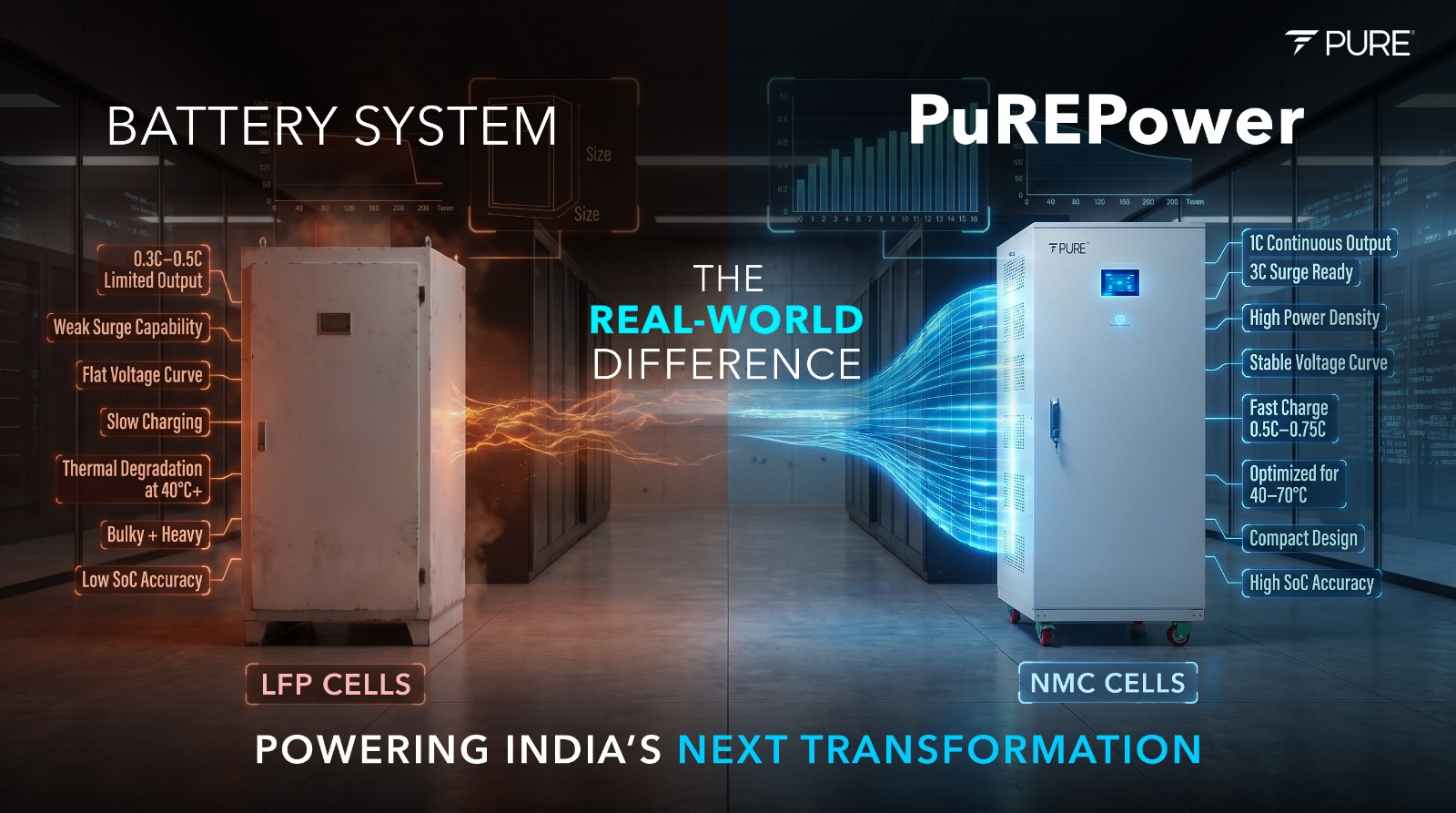
Battery Energy Storage Systems (BESS) are no longer a niche luxury for India, they are rapidly becoming a necessity. With chronic power-cut problems in Tier 2 and Tier 3 cities, soaring diesel costs, worsening air quality from generator exhaust, and a solar revolution sweeping rooftops across the country, the demand for intelligent, reliable, and high-performance energy storage has never been higher.
But not all batteries are created equal. The global energy storage market is loudly divided between two dominant lithium chemistries: Lithium Iron Phosphate (LFP) and Lithium Nickel Manganese Cobalt Oxide (NMC). Marketing narratives, primarily from Chinese LFP cell manufacturers and their distribution chains, have pushed LFP as the universal answer. Yet on Indian soil, in Indian homes, in Indian offices, and in Indian factories, the real-world evidence tells a very different story.
PuREPower has spent over 7 years, thousands of engineering hours, field installations, and deep application research, studying both chemistries in the specific context of the Indian residential, commercial, and small industrial customer. Across our entire product range from 3 KVA to 120 KVA, the conclusion has been unambiguous: NMC chemistry is decisively superior for this application space in India.
This article explains why, in technical depth, with real-world application context, and with complete transparency.
Before comparing chemistries, it is essential to understand the application environment that any BESS product must survive in India. This context is fundamentally different from Europe, North America, or Australia, the markets that dominate global BESS literature.
India’s electricity grid, despite massive investments, continues to be plagued by power interruptions across most of its geography. The pattern, however, is highly specific:
• Duration: Most power cuts in residential and commercial zones last between 30 and 90 minutes per interval, not several hours.
• Frequency: Multiple short interruptions per day are common, particularly during peak summer months (March to June) when demand surges and during monsoon season.
• Unpredictability: Unlike scheduled load-shedding (which was more common in an earlier era), modern outages are often unannounced and irregular.
This profile has a profound implication for BESS design: customers do not need batteries sized for 3–6 hours of backup. What they need is a battery capable of delivering high power quickly and reliably for short durations. The ratio of inverter output power (KVA) to battery capacity (KWh) in the Indian market typically trends toward 1:1 or even 1:0.75, meaning the nominal C-rating demand on the battery is in the range of 0.8C to 1.0C, not the gentle 0.17C to 0.33C seen in large utility-scale grid-storage projects.
India is home to one of the largest installed bases of diesel generators in the world. From apartment complexes and commercial buildings to hospitals, data centres, and factories, the diesel genset has been the default backup power solution for decades. This is not because Indians love diesel or are indifferent to pollution and fuel costs. It is because only diesel generators, until recently, could handle the high surge loads that characterise Indian electrical environments.
An air conditioner starting up draws 3× to 5× its rated running current for a fraction of a second. Elevators, submersible pumps, industrial motors, CNC machines, MRI scanners, and commercial refrigeration compressors all exhibit similar inrush current profiles. These are surge loads. A lead-acid battery inverter cannot reliably handle them. An LFP-based BESS product (as designed by most market entrants) cannot either, at least not without severe performance and life-cycle penalties.
PuREPower’s BESS products are explicitly positioned to replace diesel generators in residential, commercial, and small industrial settings. This is the application brief that drove every chemistry and engineering decision we made, and it is the reason NMC won.
India is a hot country. Vast swathes of the subcontinent experience ambient temperatures of 40–50°C during summer. In equipment rooms, server rooms, closed utility areas, and rooftop installations, temperatures can be even higher. The internal temperature of battery cells during operation can easily reach 60–70°C, sometimes higher, under high-load conditions in such environments.
Any BESS product that claims suitability for India must be designed around this thermal reality. Battery chemistry that degrades, throttles, or fails at these temperatures is simply not fit for purpose, regardless of how impressive the datasheet numbers look under controlled laboratory conditions at 25°C.
NMC cells offer a gravimetric energy density of 200–300 Wh/kg, compared to LFP’s 120–180 Wh/kg. The volumetric energy density difference is similarly significant.
For large-scale grid storage in a container the size of a shipping container, this difference is less critical, there is plenty of space and weight is not the primary concern. But for a 3 KVA to 120 KVA all-in-one BESS unit that needs to fit in:
• A living room or utility area of an apartment
• A server room or IT closet of a small office
• A plant room of a commercial building
• A wall-mounted cabinet of a retail store
…the density advantage of NMC is not just a technical nicety, it is a practical necessity. An LFP-based system would require 40–60% more volume and weight to deliver the same energy capacity. In India’s space-constrained urban environments, this is a decisive disadvantage.
Moreover, customers in the 3 KVA–120 KVA segment are extremely price-sensitive. A battery that is 2× to 3× larger (to achieve the same effective performance at Indian C-rates) is also significantly more expensive. NMC directly solves this by packing more energy into a smaller, lighter, and more cost-effective form factor.
This is the single most critical differentiator for the Indian residential and commercial BESS market. It deserves careful technical treatment.
Discharge C-rating defines how quickly a battery can release its stored energy. A 10 KWh battery discharging at 1C delivers 10 KW of power. At 2C, it delivers 20 KW. At 3C, it delivers 30 KW.
|
Charging Parameter |
NMC |
LFP |
|
Safe continuous charge rate (life-cycle preserving) |
0.5C–0.75C |
0.2C–0.3C |
|
Thermal impact of 0.5C charging at 45°C ambient |
Manageable with NPCM |
Severe degradation |
|
Solar variable-rate compatibility |
High |
Low (SoC curve issues) |
|
Fast-charge without significant cycle life penalty |
Yes |
No |
LFP’s life-cycle ratings, often quoted at 3,000–6,000 cycles, are calibrated almost exclusively at 0.3C to 0.5C constant discharge rates, under controlled temperatures of 20–25°C, and with full, balanced charge-discharge cycles. These are laboratory conditions that are almost never replicated in the field.
When LFP cells are subjected to:
• Continuous 0.8C–1.0C discharge (as required by the Indian short-backup-duration profile),
• Surge loads of 2C–3C (as generated by AC compressors, elevators, motors),
• Ambient temperatures of 40–50°C (as experienced across India),
…the degradation is no longer linear. It becomes exponential. Real-world field data from LFP-based BESS products deployed in India consistently shows life cycles of 200–500 cycles, a catastrophic shortfall against the 3,000–6,000 cycles promised in the datasheet. Products that were supposed to last 8–10 years are failing within 12–24 months.
This is not a supply chain quality issue. This is a fundamental chemistry mismatch between the cell’s design parameters and the application environment.
NMC cells, by contrast, are rated for continuous discharge at 0.75C–1C with surge capability extending to 1C to 3C. Their degradation at these rates, even under elevated temperatures, is significantly more graceful. In our 7 years of field data across thousands of PuREPower installations across India, NMC cells have consistently delivered life cycles in the 2,500–3,500 range even under Indian operating conditions due to the deployment of Smart AI, nano PCM & the 5th Gen BMS, without the catastrophic early failures that have plagued LFP deployments.
Battery Management Systems (BMS) rely on the cell voltage as a primary signal to estimate State of Charge (SoC), manage balancing, and protect cells from over-charge and over-discharge. The shape of the voltage curve under load is therefore critical.
LFP cells have a notoriously flat voltage discharge curve, the cell voltage stays around 3.3V–3.4V for most of the discharge range and then drops sharply near the end of discharge. This flat plateau creates three serious problems:
Voltage-based SoC estimation cannot accurately determine the SoC within the flat region. A cell at 80% SoC and a cell at 20% SoC can show nearly identical voltages. This makes it extremely difficult for the BMS to accurately report remaining backup time, trigger appropriate load shedding, or execute full charge cycles efficiently.
During high-rate discharge and charge cycles, the flat LFP voltage curve produces extreme voltage fluctuations at the top and bottom of the SoC range. These fluctuations destabilise passive and active cell balancing algorithms, leading to cell imbalance accumulation, some cells over-discharge while others remain undercharged. Over time, this causes permanent capacity loss and accelerated degradation.Problem 3 — Solar Charging Complications
Solar power is inherently variable, cloud cover, shading, and temperature all cause rapid fluctuations in generation. These translate into rapid charge rate variations especially disruptive near the top of charge where the flat LFP curve makes it difficult to determine when CV charging should begin. The result is incomplete charging, chronic under-utilisation of available energy, and accelerated capacity fade.
NMC cells have a more graduated, sloped voltage curve across their discharge range. This provides the BMS with a far richer voltage signal, enabling significantly more accurate SoC estimation, more effective cell balancing, cleaner integration with solar charge controllers, and proper execution of CC-CV charging profiles.
PuREPower’s 5th Generation BMS, developed specifically for NMC chemistry and Indian operating conditions, leverages this characteristic to deliver industry-leading SoC accuracy and cell balancing performance across all operating conditions.
Indian customers in the 3 KVA–120 KVA segment need their BESS to recharge quickly between power cuts. With multiple outages per day possible during summer months, the battery must be able to accept charge at meaningful rates from both the grid and solar sources during the available windows.
|
Charging Parameter |
NMC |
LFP |
|
Safe continuous charge rate (life-cycle preserving) |
0.5C–0.75C |
0.2C–0.3C |
|
Thermal impact of 0.5C charging at 45°C ambient |
Manageable with NPCM |
Severe degradation |
|
Solar variable-rate compatibility |
High |
Low (SoC curve issues) |
|
Fast-charge without significant cycle life penalty |
Yes |
No |
An LFP battery charged at 0.5C in a 40–50°C Indian environment undergoes severe, non-linear degradation. Lithium plating accelerates. SEI layer formation accelerates. Cell swelling occurs. In some documented cases in India, this combination has led to sudden cell death within 150–200 cycles, a fraction of the advertised 3,000–6,000 cycle lifespan.
NMC cells, with their wider electrochemical stability window at higher C-rates and superior thermal management characteristics, handle 0.5C–0.75C charging significantly better, especially when combined with PuREPower’s nano phase change material (NPCM) thermal management system.
The thermal behaviour of battery chemistries under real Indian ambient conditions (40–50°C, with cell temperatures reaching 60–70°C) is where the LFP marketing narrative collapses most dramatically.
What LFP advocates correctly state: LFP cells have a higher thermal runaway threshold (~270°C) compared to NMC cells (~200°C). Under extreme abuse conditions, short circuit, mechanical damage, severe overcharge, LFP is somewhat less likely to enter thermal runaway.
What LFP advocates conveniently omit: LFP cells severely degrade in performance and cycle life at temperatures above 40–45°C during normal operation. At 60–70°C cell temperature under high-rate discharge and charge:
• LFP electrolyte decomposition accelerates dramatically
• SEI (Solid Electrolyte Interphase) layer growth rate increases non-linearly
• Lithium plating during charging becomes more severe
• Internal resistance increases, further exacerbating thermal runaway risk
• Balancing becomes increasingly erratic due to temperature-induced voltage drift
For large utility-scale BESS installations (5 MWh to 100 MWh), this is mitigated through sophisticated liquid cooling systems that can cost lakhs or crores of rupees. These costs spread reasonably over a 100 MWh system. They are completely uneconomical for a 3 KVA to 120 KVA product.
NMC chemistry, while having a lower absolute thermal runaway threshold, exhibits far more graceful performance degradation at elevated operating temperatures in the 40–70°C range. NMC cells continue to deliver high discharge rates and accept proper charge cycles at these temperatures without the catastrophic exponential degradation seen in LFP.
| Parameter | NMC (PuREPower) | LFP (Typical India) | Winner for India |
| Energy density (Wh/kg) | 200–300 Wh/kg | 120–180 Wh/kg | NMC |
| Continuous discharge rate | 1C | 0.3C–0.5C | NMC |
| Surge/peak discharge rate | 3C | 0.8C–1.5C | NMC |
| Safe charging rate | 0.5C–0.75C | 0.2C–0.3C | NMC |
| Performance at 40–70°C | Good with NPCM | Severe degradation | NMC |
| Life cycles at 0.75 °C / India | 2,500–3,500 | 200–500 (field) | NMC |
| Thermal runaway threshold | ~200°C | ~270°C | PuREPower due to nano PCM |
| Voltage curve for BMS | Graduated (better) | Flat (harder) | NMC |
| SoC accuracy | High | Low at high C-rates | NMC |
| Solar variable charge compatibility | High | Low | NMC |
| Form factor (size/weight) | Compact | Bulky (+40–60%) | NMC |
| Diesel generator replacement | Yes | No | NMC |
| Liquid cooling requirement (India) | No (with NPCM) | Yes (for longevity) | NMC |
| Cost per cycle (India) | Lower | Higher | NMC |
A typical 3BHK apartment in Hyderabad’s residential zones experiences 2–4 power cuts daily during summer, each lasting 20–40 minutes. The household runs two 1.5-ton split ACs, a refrigerator, LED lighting, fans, a television, and a washing machine.
The critical load profile includes:
• AC compressor start-up surge: ~2.5–3.5 KW spike for 2–3 seconds
• Combined running load during outage: 3–4 KW continuous
• Required backup duration: 60–90 minutes
The appropriate BESS specification is approximately 5 KVA / 5 KWh, with a continuous C-rate of ~1.0C and surge C-rate of ~2C to 3C.
An LFP-based 5 KVA BESS with standard 5 KWh capacity:
• Struggles to deliver the AC start-up surge without voltage sag
• Degrades rapidly at 1C continuous in 40°C ambient
• Requires oversizing to 8–10 KWh to maintain adequate C-rates, adding ~₹40,000–₹60,000 to cost
• Likely fails within 18–24 months under Indian conditions
A PuREPower NMC-based 5 KVA BESS:
• Handles AC start-up surges natively without voltage sag
• Maintains 1C continuous discharge efficiently with NPCM thermal management
• 5 KWh capacity is sufficient, no oversizing required
• Delivers 7–12 years of reliable operation under Indian conditions
A 6-floor commercial building in Chennai houses IT companies, a few retail outlets, a canteen, and conference rooms. The building has a 100 KVA sanctioned load including 20 ACs, elevators, computer equipment, and server room.
Current situation: One 82 KVA diesel generator running approximately 4–6 hours/day during power cuts and peak demand periods.
• Annual diesel cost: ~₹12–15 lakhs
• Maintenance cost: ~₹1.5–2 lakhs/year
• Carbon emissions: Significant, increasingly an ESG concern for tenants
A 120 KVA PuREPower NMC BESS with rooftop solar:
• Handles elevator motor inrush current (2.5C–3C surge) reliably
• Provides continuous backup for all office loads at ~1C discharge
• Charges from solar during the day and from grid at off-peak rates at night
• Eliminates diesel fuel cost and generator maintenance
• ROI period: 3–4 years, followed by ~₹10–15 lakh/year savings
• Qualifies for accelerated depreciation under Indian Income Tax Act (40% in Year 1)
An LFP-based 120 KVA system in this scenario:
• Would require ~200–240 KWh of LFP battery capacity to match the effective performance of 120 KWh NMC (due to C-rate oversizing requirement)
• Would still underperform on elevator and AC surge loads
• Would struggle to survive Chennai’s 38–44°C ambient without liquid cooling infrastructure
• Liquid cooling addition adds ₹8–15 lakhs to the system cost, eliminating the cost advantage
A 50-person textile unit runs spinning and weaving machines with induction motors across a 60 KVA connection. Power cuts of 45–60 minutes occur 3–4 times daily, and the existing diesel generator consumes ~800 litres/month.
Diesel spend: ~₹8–10 lakhs/year
A 60 KVA PuREPower NMC BESS:
• Handles induction motor start-up surges (the most demanding surge loads in industrial applications)
• Provides seamless power transition during cuts (sub-10ms switchover, critical for precision machinery)
• Integrates with rooftop solar to reduce grid import during production hours
• Eliminates diesel dependency and associated CPCB regulatory compliance burden
• Provides cleaner, more stable power than a diesel generator, improving motor life and fabric quality consistency
The final argument that often surfaces in favour of LFP is cost: LFP cells are cheaper per KWh of nameplate capacity. This is true at the cell procurement level. But when the full economic picture is drawn, the calculation inverts dramatically.
| Metric | NMC (PuREPower) | LFP (Indian Field Data) |
| Nameplate cycles | 2,500–3,500 | 3,000–6,000 |
| Actual cycles at 0.75C, 45°C | 2,500–3,500 | 200–500 |
| Usable capacity at end of life | ~80% | ~60% (due to degradation) |
| Battery cost (5 KVA / 5 KWh) | ₹1.5–1.8 lakh | ₹1.1–1.4 lakh |
| Effective cost per actual cycle | ₹75–120 | ₹220–700 |
| Replacement frequency (India) | 7–10 years | 1.5–2 years |
The LFP battery that appears cheaper at purchase is 3×–6× more expensive on a cost-per-cycle basis under Indian operating conditions. Factor in replacement costs, installation costs, downtime, and the inconvenience factor, and NMC’s economic superiority is overwhelming.
| Cost Category | Diesel Generator (Annual) | PuREPower NMC BESS (Amortised Annual) |
| Fuel (₹) | ₹1.5–15 lakh | ₹0 (solar + off-peak grid) |
| Maintenance (₹) | ₹50,000–2 lakh | ₹15,000–50,000 |
| Depreciation / Replacement | High (gen-set life ~8–10 yrs) | Moderate (BESS life ~8–10 yrs) |
| Pollution / Compliance | CPCB compliance costs | Zero |
| Fuel Price Risk | High (diesel price volatile) | None |
| Power Quality | Poor (voltage/frequency fluctuations) | Excellent (pure sine wave, regulated) |
A PuREPower NMC BESS with hybrid solar achieves full replacement of diesel generator functionality while delivering cleaner power at lower long-term cost. The hybrid solar component further reduces grid electricity dependency, improving economics and providing energy independence.
PuREPower’s engineering team recognised early that thermal management was the critical design challenge for high-performance NMC cells in Indian conditions, and that liquid cooling was not an economically viable solution for the 3 KVA–120 KVA product range.
The breakthrough came through the integration of indigenous nano phase change materials (NPCM) within every PuREPower battery module. NPCMs are materials engineered at the nanoscale to absorb and release thermal energy through phase transitions (typically solid-to-liquid) at precisely controlled temperatures. When integrated into the cell assembly:
• The NPCM absorbs excess heat generated during high-rate discharge and charge events, preventing localised hot spots
• Cell temperatures are stabilised within the optimal operating window, even during 2C–3C surge events
• The system self-regulates passively, no pumps, no compressors, no additional power consumption, no mechanical failure modes
The result has been remarkable: zero thermal incidents across all PuREPower products over 7 years of field deployment, across thousands of installations in Telangana, Rajasthan, Gujarat, Maharashtra, Tamil Nadu, Andhra Pradesh, and other high-temperature states. This is a safety and reliability record that speaks for itself.
PuREPower’s BMS, now in its 5th generation, has been purpose-built for NMC chemistry operating under Indian conditions. Key capabilities include:
• AI-driven SoC estimation using multi-variable algorithms that factor in temperature, discharge rate, cycle history, and cell ageing, not just voltage
• Predictive cell balancing that anticipates imbalance trends before they become critical, rather than reacting to voltage deviations
• Dynamic C-rate management that allows controlled 2C–3C surge delivery while protecting individual cells from cumulative stress
• Solar charge optimisation tuned to handle variable irradiance patterns including rapid cloud-cover transitions
• Thermal-aware charging protocols that automatically adjust charge rates based on real-time cell temperature monitoring
• Cycle life prediction and reporting that gives customers accurate estimates of remaining battery life based on actual usage patterns
This BMS architecture, built specifically around NMC’s electrochemical characteristics, unlocks the full potential of NMC chemistry while managing its sensitivities, particularly the thermal dimension that LFP critics often cite.
PuREPower’s choice of NMC chemistry for smaller residential and commercial BESS products is not an isolated engineering opinion. The world’s most successful and scrutinised energy storage companies have reached the same conclusion.
Tesla’s Powerwall product line, the global gold standard for residential BESS, uses NMC/NCA (Nickel Manganese Cobalt) chemistry. Tesla’s engineers, with access to all available chemistries and essentially unlimited R&D budget, chose NMC/NCA for exactly the reasons PuREPower identified:
• Higher energy density for a compact, wall-mounted form factor
• Superior power delivery for high-surge residential loads (AC units, pool pumps, washing machines)
• Better performance across the operating temperature range of residential environments
• Compatibility with variable solar charging profiles
Tesla has explicitly designed Powerwall around the assumption that it will handle full household loads including large appliances, the same application requirement that drives the Indian BESS market. Tesla Powerwall’s peak power delivery of 7 KW continuous / 10 KW peak from a 13.5 KWh battery implies a peak C-rate of approximately 0.74C, but this is for a Western household with relatively modest surge loads. For Indian conditions with higher surge-load profiles, the case for NMC’s power density is even stronger.
Enphase Energy, the world’s largest microinverter company and a global leader in solar-plus-storage, transitioned to NMC chemistry with the IQ Battery 10T for their flagship storage product. This transition was driven by performance requirements in solar-integrated applications, specifically the need for the battery to handle variable charge rates from solar and deliver reliable power for domestic loads.
Enphase’s engineering team found, as PuREPower had independently discovered, that LFP’s flat voltage curve and sensitivity to variable charge rates made it a suboptimal choice for solar-integrated applications where charge current is not constant. NMC’s more responsive voltage characteristics and superior charge-rate compatibility made it the better fit.
LG Chem’s RESU (Residential Energy Storage Unit) line, widely deployed in Europe, Australia, and the United States, uses NMC chemistry. SolarEdge’s battery storage products similarly leverage NMC for the same power density and surge handling reasons. Both companies serve high-ambient-temperature markets (Australia, Middle East) where the thermal performance of the battery under real-world conditions is a critical selection criterion, precisely the condition that India exemplifies.
BYD and CATL have been highly effective at marketing LFP chemistry through their massive scale advantages and cost competitiveness. Their LFP products work well in specific applications:
• Grid-scale projects (10 MWh and above) with active liquid cooling and 0.17C–0.33C discharge rates
• Electric vehicles used in mild-climate urban environments with regenerative braking (which means the average discharge C-rate is lower than it appears)
• Stationary storage in climates where ambient temperatures rarely exceed 30°C
None of these conditions match the Indian residential/commercial BESS application brief. Yet the global LFP marketing machine, driven by the sheer scale of Chinese cell manufacturing, has pushed LFP into every market without adequate consideration of local application realities. The consequences are now visible across India in the form of failed LFP BESS products, customer complaints, and a growing graveyard of batteries that died within 1–2 years of deployment.
LFP advocates often invoke the thermal runaway temperature advantage of LFP (approximately 270°C vs. NMC’s 200°C) as a reason to prefer LFP in all applications. This deserves a fair, honest response.
The thermal runaway threshold matters only under abuse conditions, severe overcharge, external short circuit, mechanical damage, or internal short circuit. In a properly designed BESS product with a high-quality BMS and appropriate cell-level protection, these abuse conditions should not occur. PuREPower’s BMS provides multiple layers of protection against every abuse scenario, cell-level fusing, multi-stage over-voltage and over-current protection, temperature-triggered shutdown, and a physical and mechanical design that prevents cell deformation under any foreseeable installation condition.
In 7 years of field operation across thousands of PuREPower NMC BESS installations in India’s highest-temperature states, there has been zero thermal incident. This is a direct consequence of:
• Nano Phase Change Material (NPCM) integration, preventing localised hot spots and keeping cell temperatures within safe windows
• 5th Generation AI BMS firmware, continuously monitoring 32+ parameters per cell and intervening before any threshold is approached
• High-quality NMC cell selection, using only cells from Tier-1 manufacturers with consistent quality control and traceability
• Conservative system design, derating cells appropriately for Indian operating conditions rather than running at the edge of specifications
Thermal safety is not a property of chemistry alone. It is a property of the system. A poorly designed NMC system is dangerous. A well-designed NMC system with proper thermal management and BMS protection is as safe as, or safer in practice than, an LFP system deployed without adequate attention to India’s unique operating conditions.
Intellectual honesty requires acknowledging that LFP is not universally inferior. There are applications where LFP is the right choice:
• Grid-scale BESS (10 MWh and above) with active liquid cooling, 0.17C–0.33C discharge rates, and controlled environments, LFP’s cycle life at these gentle rates is excellent, and the higher thermal runaway threshold is an additional safety margin for very large installations.
• Mild-climate stationary storage in temperate regions (Europe, Canada) where ambient temperatures rarely exceed 25°C and discharge C-rates are low.
• Utility-scale solar farms requiring multi-hour dispatch at very low C-rates.
In these applications, which are fundamentally different from the Indian residential/commercial/small-industrial BESS market, LFP’s characteristics are well-matched. The problem is not LFP chemistry per se. The problem is the indiscriminate application of LFP to every energy storage use case, driven by cost economics and manufacturing scale rather than application-specific engineering rigour.
PuREPower’s position is not anti-LFP. It is pro-engineering: the right chemistry for the right application. For India’s 3 KVA–120 KVA hybrid solar BESS market, that chemistry is unambiguously NMC.
The Indian energy storage market is at an inflection point. Millions of households and businesses are evaluating BESS products, many for the first time. They are making decisions based on incomplete information, marketing claims rather than engineering substance, and global narratives that do not account for India’s specific realities.
The wave of LFP-based BESS products that have failed in Indian conditions, delivering 200–500 cycles instead of the promised 3,000–6,000, unable to start ACs and motors reliably, degrading catastrophically in the summer heat, has damaged customer trust and set back the legitimate energy storage market.
PuREPower’s mission, built on 7 years of India-specific engineering, field learning, and customer feedback, is to deliver what Indian customers actually need: an all-in-one hybrid solar BESS that replaces the diesel generator, works reliably at Indian C-rates, survives Indian temperatures, and delivers a true 7–12 year service life.
That product, from 3 KVA to 120 KVA, is built on NMC chemistry, nano phase change material thermal management, and 5th Generation AI BMS. Not because NMC is fashionable or because the marketing says so. Because the engineering demands it.
For India’s residential, commercial, and small industrial BESS applications, NMC is not a compromise. It is the correct answer.


 Call Now
  PuREPower Dealership
  PuREPower Enquiry Now