
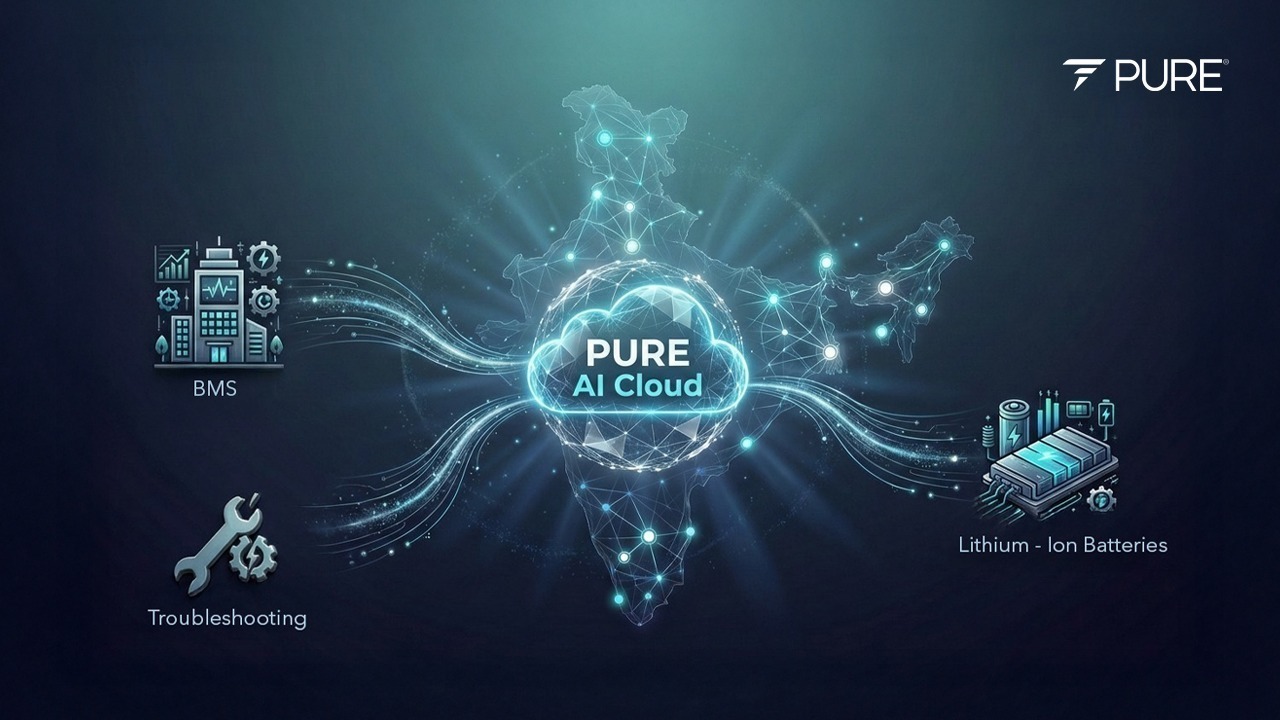
A Technical Case Study on Integrating Stochastic Optimization, RAG Architectures, and Multi-Agent Systems (MAS) in Energy Storage.
The Shift to Cyber-Physical Systems (CPS)
As the academic and industrial community convenes in New Delhi for the AI Impact Summit, the discourse must evolve from theoretical applications to deployed Cyber-Physical Systems (CPS).
At PURE Energy, incubated within the research ecosystem of IIT Hyderabad under the leadership of Nishanth Dongari and Rohit Vadera, we have moved beyond standard manufacturing paradigms. We are treating Energy Storage Systems (ESS) not merely as electrochemical assets but as edge nodes in a distributed intelligent network.
This technical disclosure outlines how PURE Energy has architected a Multi-Agent System (MAS) framework to resolve high-dimensional optimization problems across R&D, grid synchronization, fault diagnostics, and commercial operations. This is our blueprint for the AI-Native Industrial Entity.
1. Edge Intelligence & Stochastic Control: The PuREPower BMS
The core differentiator of the PuREPower product line lies in its transition from deterministic logic to probabilistic control strategies.
Telemetry & Data Ingestion
Our proprietary Battery Management System (BMS) functions as a high-frequency data acquisition unit. It streams granular telemetry across three vectors:
i. Electrochemical State: Cell-level impedance spectroscopy and voltage deviation analysis (dV/dQ) wrt 1st order and 2nd order.
ii. Thermal Dynamics: Real-time heat dissipation modeling correlated with ambient temperature sensors.
iii. Grid/Solar Stochasticity: Input monitoring of solar irradiation variance and grid voltage fluctuations.
Predictive Algorithms & Closed-Loop Control
Launched in mid 2024, our predictive engine utilizes Recurrent Neural Networks (RNNs) and transformer-based models to perform:
i. State of Health (SoH) Estimation: Moving beyond Coulomb counting to data-driven degradation modeling.
ii. Dynamic Load Balancing: Real-time optimization of the Charge/Discharge profile based on predicted load curves.
iii. Preventative Anomaly Detection: The system identifies outliers in cell behavior (e.g., micro-short circuits) before thermal runaway thresholds are breached, triggering preemptive maintenance protocols via Over-The-Air (OTA) firmware patches.
Take the first step toward smarter, sustainable living. Request your personalized quote at:
https://www.pureenergy.co.in/enquiry-now/
2. Dynamic Arbitrage & Grid-Interactive Optimization (The Financial Engine)
Our system leverages a Stochastic Model Predictive Control (MPC) framework to solve the multi-objective optimization problem of minimizing Levelized Cost of Energy (LCOE) while ensuring Quality of Service (QoS). With the implementation of Time-of-Day (ToD) and Time-of-Use (ToU) dynamic tariff policies across Indian DISCOMs (Commercial/Industrial >10kW), the PuREPower All-in-One Energy Storage System functions as an automated high-frequency trading desk for energy.
Operational Logic:
i. Solar-First Prioritization (The Rebate Window): During the "Solar Hours" (typically 10:00 – 16:00), where DISCOM tariffs often feature a ~20% rebate, the AI prioritizes Direct-to-Load (DTL) consumption. Simultaneously, if Solar Power exceeds Load Demand, the excess is not blindly exported. The Agent calculates the Marginal Opportunity Cost: if the evening Peak Tariff is predicted to be higher than the current feed-in tariff, the system diverts energy to charge the Battery instead of exporting, effectively "storing" cheap solar electrons to displace expensive grid electrons later.
ii. Peak Shaving (The Surcharge Avoidance): During evening peak hours (typically 18:00 – 22:00) when grid surcharges apply, the system automatically isolates from the grid or limits grid draw to a baseline minimum, discharging the battery to service the load. This flattening of the load curve directly reduces Maximum Demand Charges (often 15-20% of a commercial bill).
iii. Strategic Grid Charging: In rare scenarios where Solar Irradiance is low and battery SoC is critical, the AI identifies the deepest "Off-Peak" grid slot (e.g., 02:00 – 05:00) to charge the battery at the lowest possible tariff, ensuring full backup capability for the next business day without incurring peak-hour costs.
iv. Diesel Synchronization (DG-Sync): For industrial users with Diesel Generators, the system utilizes a Zero-Crossing Detector to seamlessly synchronize phase and frequency. The AI controls the DG as a "slave," running it only at its most efficient Break-Specific Fuel Consumption (BSFC) point to charge the battery rapidly during extended outages, then shutting it down to run the load on silent battery power, reducing fuel OpEx by up to 40%.
3. Distributed Fault Tolerance: The Cloud-Edge RAG Architecture
To address the scalability of technical support in a linguistically diverse demographic, we engineered a Retrieval-Augmented Generation (RAG) architecture on the cloud.
The Diagnostic Pipeline
The system operates on a "Check-Verify-Act" loop:
i. Edge Trigger: The local BMS detects a fault code (e.g., Inverter Sync Failure).
ii. Cloud Inference & Automation: The error log is uploaded to the Google Cloud instance, where an AI agent correlates the fault with historical data and the specific firmware version. Entire complex series or/and parallel work-flows are automated through platforms like n8n.
iii. Automated Voice Interface: If a critical intervention is required, the system initiates a Voice-Based SIP Call to the site operator.
Natural Language Understanding (NLU)
Unlike static IVR systems, this agent utilizes Speech-to-Text (STT) and Text-to-Speech (TTS) pipelines fine-tuned on Indian regional dialects. It accesses a vectorized knowledge base of technical manuals to provide step-by-step debugging instructions (e.g., Check Neutral-Earth Voltage), effectively closing the loop between fault detection and remediation without human latency.
4. Commercial Intelligence: Verticalized Agents on Google Cloud AI
In Feb 2026, PURE Energy deployed a hierarchical Multi-Agent System for commercial operations, built on Google Cloud AI with Custom LLMs built upon the base models like Gemini/Claude/OpenAI/DeepSeek, and indeed the data being hosted either in Indian servers or/and native servers at PURE Energy.
Architectural Hierarchy
The system mimics a corporate organizational structure using specialized agents:
i. L1 Agents (Executive): Handle high-throughput lead qualification and initial data parsing.
ii. L2 Agents (Technical Sales): Fine-tuned on high-dimensional product data (datasheets, C-ratings, cyclic life curves, load balancing details). These agents perform comparative analysis against various solutions for better decision making in real-time.
iii. Workflow Orchestrators: Automate CRM injections and quotation generation based on the conversation context.
Adversarial Evaluation (Red Teaming)
To ensure robustness, we deployed "Counter Agents"—adversarial models programmed to simulate skepticism and technical edge cases. The sales agents undergo continuous reinforcement learning (RLHF) against these adversaries to refine their reasoning capabilities before deployment.
Human-in-the-Loop Protocol
The system enforces a handover protocol for complex channel negotiations, ensuring that human experts (RSMs) are deployed only for high-value strategic closures, optimizing human resource allocation.
5. The Engineering Philosophy: Domain-Specific AI Development
The failure rate of outsourced AI Agents in deep-tech sectors is very high. This stems from the decoupling of Domain Knowledge from Algorithmic Implementation.
Founder-Led Architecture
At PURE Energy, the agent architecture was defined by the Founders and CXOs, domain experts in energy systems, business context and data centres/cloud computing, and this was an effort of the last 18 months.
i. Constraint Definition: We hard-coded the physical and business constraints into the agent's logic.
ii. Knowledge Graph Construction: We personally curated the datasets used for RAG, ensuring the AI understands the nuance between Rated Power and Peak Power.
This "Domain-First" approach ensures that our agents are not generic LLMs but specialized expert systems.
This transition allows our human workforce to pivot from Data Processing to Strategic Engineering, focusing on grid modernization and battery chemistry research while AI handles the deterministic workflows.
Join our expanding partner network and contribute to powering India’s future. Learn more by visiting:
https://www.pureenergy.co.in/dealership-enquiry/
6. Conclusion: The Future is Algorithmic
The convergence of IIT Hyderabad’s research rigor and PURE Energy’s deployment velocity serves as a validation of the Lab-to-Market model. We are demonstrating that AI is not an auxiliary tool but the fundamental substrate of modern manufacturing.
Currently, our Multi-Agent System (MAS) architecture generates and processes a high-throughput inference load of 300 to 400 million tokens per day. This data stream is not merely ephemeral conversational text; it comprises structured telemetry logs converted to tokenized sequences, high-fidelity ASR (Automatic Speech Recognition) transcripts from vernacular support calls, and complex RAG retrieval chains.
The 10-Billion Token Trajectory: As we scale our operations, our projection models indicate a surge to 10 Billion tokens per day within the next 2 to 3 years. This exponential accumulation of proprietary data transitions PURE Energy from an AI-Consumer to an AI-Creator. We are effectively curating one of the world's largest labeled datasets specifically for Tropical Energy Storage & Indian Grid Dynamics.
Domain-Adaptive Pre-Training (DAPT): This massive corpus lays the foundation for training a Domain-Specific Large Language Model (Energy-LLM) tailored for the Indian subcontinent. Unlike general-purpose foundation models, this specialized model will undergo Continued Pre-Training (CPT) on a curated diet of:
i. Regulatory Corpora: Central Electricity Authority (CEA) technical standards, CERC/SERC tariff orders, and the Indian Electricity Grid Code (IEGC).
ii. Physics-Informed Data: Electrochemical time-series data (Voltage/Current/Temp) aligned with Li-ion degradation physics (Arrhenius/Peukert models).
iii. Vernacular Semantics: A distinct vocabulary covering technical energy terminology in Hindi, Telugu, Tamil, and other regional languages, enabling superior NLU (Natural Language Understanding) for rural deployment.
Strategic Outcome: By fine-tuning on this hyper-specific dataset, we aim to reduce hallucination rates in technical diagnostics to near-zero and achieve lower inference latency compared to generic heavy-weight models. This creates a defensible IP moat: an AI that natively "speaks" the language of India’s power grid.
To the academic and engineering community: The era of the Cognitive Factory is here.


 Call Now
  PuREPower Dealership
  PuREPower Enquiry Now