
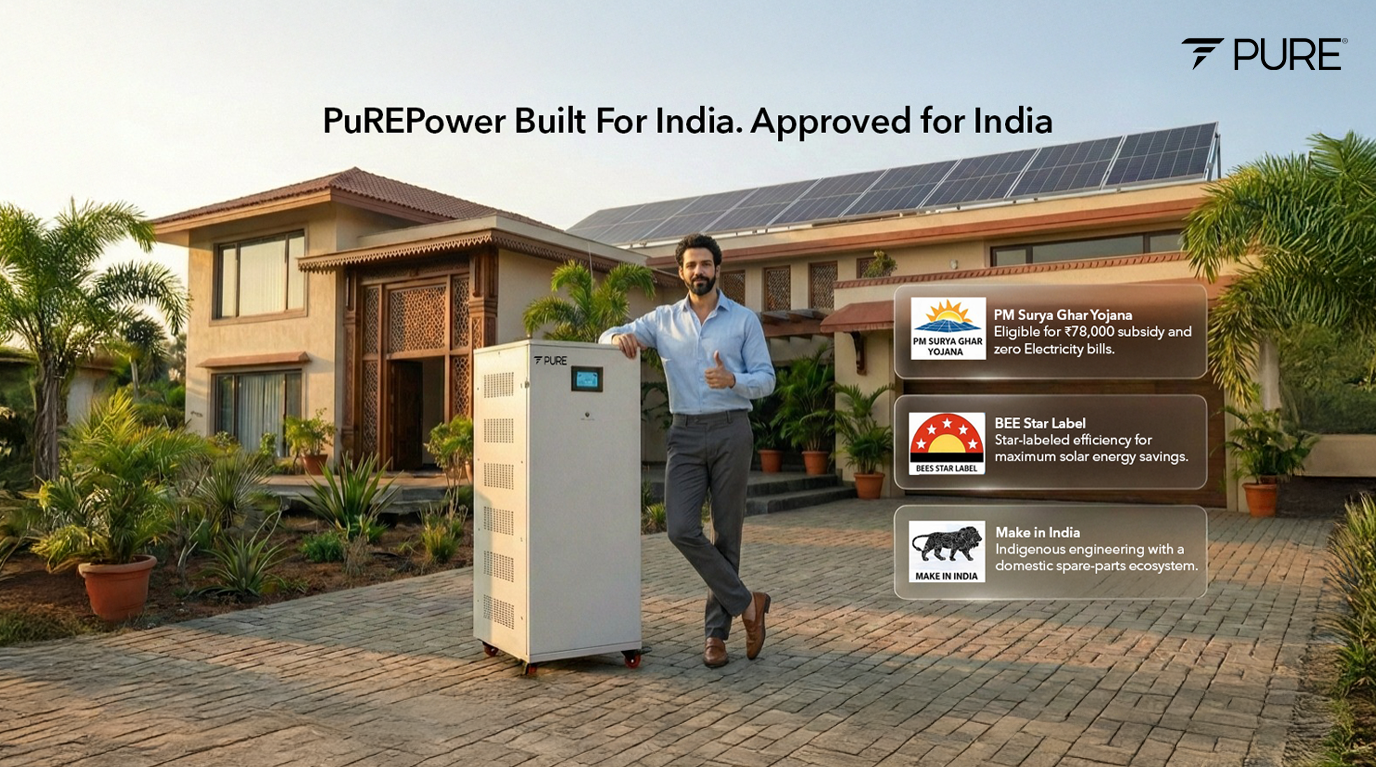
Introduction: The Great Indian Energy Shift
India is currently navigating one of the most aggressive energy transitions in modern history. The launch of the PM Surya Ghar: Muft Bijli Yojana is not merely a subsidy scheme; it is a structural overhaul of the national grid, decentralizing power generation to 1 crore rooftops. However, as the market floods with demand, a critical chasm has opened between availability and reliability.
For stakeholders, whether homeowners, distributors, or government procurement officers, the challenge has shifted. It is no longer about finding a solar product; it is about filtering out the noise of sub-standard imports to find infrastructure that will survive the next decade.
PuREPower Home products are eligible for PM Surya Ghar Subsidy of 78,000 rupees. PuREPower has strategically positioned itself not just as a participant in this ecosystem, but as the benchmark for compliance and engineering integrity. By securing stringent alignments with the Bureau of Energy Efficiency (BEE), the Government e-Marketplace (GeM), and automotive-grade safety standards, PuREPower is addressing the silent anxieties of the solar market: safety, longevity, and supply chain sovereignty.
This analysis explores the technical and economic pillars of PuREPower’s onboarding with India’s renewable roadmap.
1. The Policy Nexus: Decoding PM Surya Ghar Eligibility
The government’s ambition to provide "Muft Bijli" (free electricity) through 300 units of solar power is contingent on efficiency. A solar system is not a passive appliance; it is a mini-power plant. If the plant is inefficient, the math of the subsidy collapses.
The Engineering of Eligibility
PuREPower’s hybrid solar integration does not just "fit" the scheme; it is optimized for it. The government has established non-negotiable criteria to ensure that taxpayer money funds assets, not liabilities. PuREPower has confirmed full adherence to these technical mandates. This compliance ensures that when a dealer sells a PuREPower unit, they are selling a guaranteed ticket to central subsidies. There is no friction, no ambiguity, and no risk of rejection during the net-metering application process.
The "Zero-Bill" Mechanics: MPPT Precision
Achieving a "Zero Electricity Bill" requires extracting every possible electron from the photovoltaic panels. In the Indian context, this is complicated by partial shading due to dust, trees, or neighboring buildings often blocking sunlight for parts of the day.
Standard inverters often fail here, dropping total output significantly if even one panel is shaded. PuREPower utilizes advanced multi-stage Maximum Power Point Tracking (MPPT). These trackers dynamically isolate shaded areas and optimize the voltage of unshaded panels in real-time. This ensures that the 300-unit target is not a theoretical maximum, but a practical monthly reality for the homeowner, maximizing the financial return on the government’s investment.
Request a personalised quote for your home at
https://www.pureenergy.co.in/enquiry-now/
2. Redefining Safety: The Automotive Standard
The Lithium-Ion battery industry in India has faced scrutiny following thermal incidents in the electric mobility sector. This has created a consumer trust deficit. Most BESS (Battery Energy Storage System) manufacturers adhere to standard stationary storage certifications, which are adequate but not exceptional.
PuREPower has taken a different path: Safety Over-Engineering.
The AIS 156 Phase 2 Differentiator
PuREPower has subjected its storage products to testing under AIS 156 Phase 2/Part 3. This is a critical distinction. AIS 156 is India's automotive-grade lithium battery safety standard — PuREPower voluntarily meets this higher bar even though BESS products are not required to.. It assumes the battery will be subjected to crashes, extreme vibrations, rapid charging cycles, and intense heat.
By applying this automotive-grade standard to stationary home batteries, PuREPower effectively eliminates the risk profile. A battery built to survive a vehicle crash is exponentially safer sitting quietly in a garage.
i. Thermal Runaway Protection: The core of this certification is preventing fire propagation. If one cell overheats, the engineering ensures it does not trigger a chain reaction in neighboring cells.
ii. Peace of Mind: For the residential user, this means the safety protocols protecting their home are superior to those required by law.
BIS: The Baseline of Trust
Beyond the advanced AIS standards, the foundational BIS (Bureau of Indian Standards) certification is present on all All-In-One Solar Integrated products. In an unregulated market where grey-market imports often bypass safety checks, BIS is the dividing line between legitimate industrial hardware and dangerous electronics. PuREPower’s strict adherence here protects dealers from liability and consumers from hazard.
3. Grid Resilience: Engineered for the Indian Reality
Designing power electronics for India requires acknowledging a harsh reality: The Indian Grid is volatile. In many regions, nominal 230V power can swing wildly between 170V and 270V. European or American-designed inverters often trip or fail under these conditions because their protection relays are too sensitive for the Indian environment.
Wide-Range Voltage Handling
PuREPower products are engineered with wider input voltage windows specifically calibrated for the Indian subcontinent.
i. Grid Export Stability: For net metering to function, the solar inverter must synchronize with the grid. If the grid voltage fluctuates, standard inverters disconnect to protect themselves, meaning the homeowner stops exporting power and loses money. PuREPower systems maintain synchronization through wider variances, ensuring continuous export credits.
ii. Load Longevity: By stabilizing the output voltage regardless of input fluctuations, the system acts as a firewall, protecting expensive home appliances (Air Conditioners, PCs, Motors) from the grid’s unpredictability.
The Efficiency Mandate: BEE Star Labelling
The Bureau of Energy Efficiency (BEE) Star Label is not just a sticker; it is a verification of conversion efficiency. Inverters lose energy as heat during the conversion of DC (Solar) to AC (Home) power. PuREPower has pushed its engineering to exceed standard efficiency benchmarks. Higher efficiency means less heat generation, which acts as a secondary mechanism for prolonging component life and more usable power per watt of sunshine.
4. Supply Chain Sovereignty: The "Make in India" Economic Engine
In the post-pandemic world, the phrase "Make in India" has evolved from a slogan to a strategic necessity known as "Supply Chain Sovereignty." Reliance on imported kits creates vulnerability.
Vertical Integration vs. Assembly
A significant portion of the Indian BESS market consists of "screw-driver technology" i.e local brands simply assembling imported Chinese kits. PuREPower distinguishes itself through genuine vertical and backward integration. The products are Designed in India and Made in India.
i. For the Dealer: This eliminates the "Spare Part Nightmare." When a product is imported, a failure often means waiting weeks for a replacement board from overseas. PuREPower’s indigenous ecosystem means support and spares are domestic and immediate.
ii. Domestic Content Preference (DCP): By manufacturing locally, PuREPower hardware qualifies for DCP. This is a critical eligibility criterion for many state and central tenders, giving PuREPower partners an automatic advantage in the bidding process.
Diversified Vendor Ecosystems
PuREPower has insulated itself from geopolitical shocks. By cultivating a diversified large vendor ecosystem across various geographies, while anchoring the core supply chain indigenously, the company eliminates the risk of localized disruptions. Whether it is a semiconductor shortage in Taiwan or a shipping crisis in the Red Sea, PuREPower’s production lines have the redundancy to keep moving.
5. Commercial Viability and Market Trust
For the B2B ecosystem that includes distributors, installers, and commercial buyers; product reliability translates directly to business viability.
The GeM Portal Validation
Listing on the Government e-Marketplace (GeM) is a rigorous process involving background checks, financial vetting, and technical audits. PuREPower’s presence on GeM will be a high-level signal of legitimacy.
i. Public Procurement: It opens the door to supplying PSUs, defense, and railways.
ii. Private Trust: For private buyers, the GeM listing serves as a proxy for due diligence. It confirms that the OEM has been vetted by the highest authorities in the land.
Tender Readiness for Rural Deployment
The PM Surya Ghar scheme will heavily involve local administrative bodies (Panchayats and Municipalities). These bodies issue tenders that mandate BIS certification and often prioritize GeM-listed sellers. PuREPower’s compliance status makes its dealers "Tender Ready" from Day 1. They can bid for local infrastructure projects with the confidence that their technical bid will not be disqualified.
Learn more about our products and dealership opportunities at
https://www.pureenergy.co.in/dealership-enquiry/
Regulatory Immunization
The Ministry of Power and MNRE occasionally issue "Quality Control Orders" (QCOs) to crack down on non-standard electronics. Dealers holding non-compliant stock risk seizure and financial ruin during these crackdowns. Stocking PuREPower is a hedge against regulatory risk. It is a fully compliant asset class that protects the dealer’s balance sheet.
6. The Service Guarantee: A Decade of Assurance
The most overlooked aspect of the solar industry is the "Decade Horizon." A solar system is expected to last 20 to 25 years. A warranty is meaningless if the company offering it lacks the infrastructure to service it.
Smart-Grid Monitoring
PuREPower mitigates the need for physical service calls through advanced Remote Monitoring.
i. Predictive Analytics: The system can alert the user or the installer to performance anomalies (e.g., a drop in panel efficiency due to dust) before they become critical failures.
ii. Smart-Grid Ready: As India moves toward Time-of-Day (ToD) tariffs and smart grids, PuREPower systems are software-ready to adapt, allowing users to arbitrage electricity rates by storing cheap power and using it when grid prices are high.
The Human Network
Technology is backed by a deploying nationwide service network. This ensures that the promise of PM Surya Ghar is sustained. The goal is not just to install 1 crore systems, but to keep 1 crore systems running at peak efficiency. This commitment to service creates a feedback loop of trust, leading to high referral rates for installers.
Conclusion: The Convergent Solution
The success of India's solar revolution will not be defined by the quantity of panels imported, but by the quality of the infrastructure installed. It requires a convergence of safety, policy alignment, and indigenous engineering.
PuREPower has effectively positioned itself at this convergence point.
i. For the Government: It is the ideal partner for achieving energy independence mandates.
ii. For the Dealer: It is a risk-free, high-velocity product backed by domestic support.
iii. For the Consumer: It is the safest path to a zero-electricity bill.
As the PM Surya Ghar scheme accelerates, the market will inevitably separate into those who sell commodities and those who provide solutions. PuREPower, with its certifications, safety protocols, and manufacturing depth, has firmly established itself as the latter. We are not just ready for the energy transition; we are powering it.


 Call Now
  PuREPower Dealership
  PuREPower Enquiry Now