
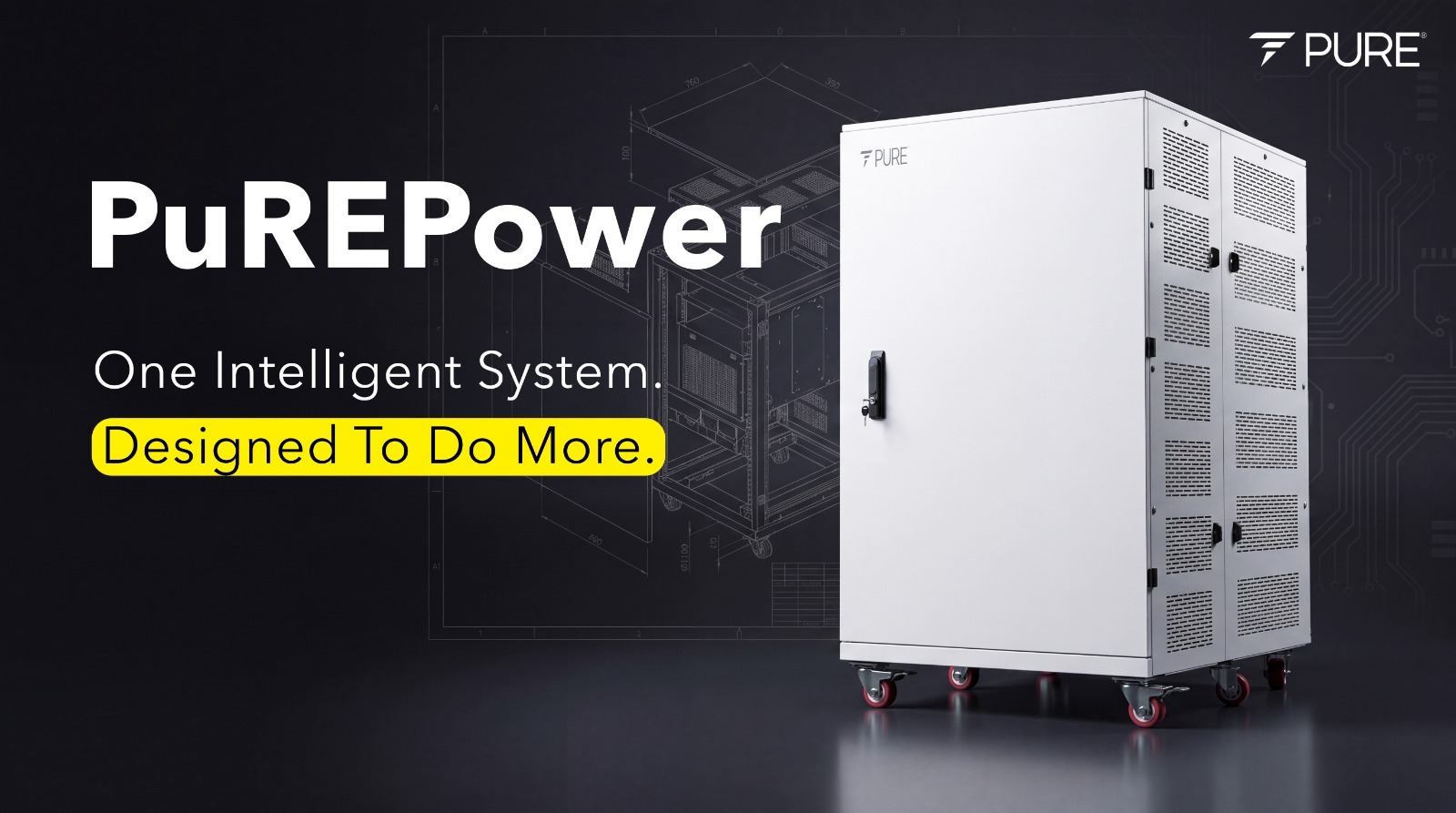
There are plenty of inverters, batteries and backup boxes on the market. Most of them do one job, do it adequately, and leave the rest of the problem for you to solve with a second purchase and a third. The PuREPower 60.0 was designed from a different starting question, not "how do we make a battery?" but "what does an Indian business actually need to never think about power again?"
The answer turned out to be a long list. So rather than bolt features onto an existing product, our engineers built a single commercial battery energy storage product around them. The result is a 60 kVA / 60 kWh all-in-one hybrid-solar BESS that behaves less like a gadget and more like a quiet, intelligent member of your team.
In our launch article we introduced what the 60.0 is and who it is for. This one goes a level deeper into why it feels so different in the field. There are dozens of clever touches inside the cabinet, but they cluster naturally into six big reasons. Here they are, explained in plain language, with the benefit you actually feel, not just the spec sheet you skim past.
Walk through most commercial buildings and you will find power handled by a committee of machines that do not talk to each other. A diesel generator out back for the heavy backup. An inverter with a room of batteries for the lighter loads. A grid-tied solar array on the roof that, frustratingly, switches itself off the moment the grid fails. Three suppliers, three service contracts, three things to go wrong, and three places for the buck to stop being passed.
PuREPower 60.0 folds all three jobs into one floor-standing cabinet. Inside sits a powerful three-phase inverter, a 60 kWh lithium battery and a 12-channel solar charger, engineered to work as one integrated system rather than three appliances wired together. It backs up your loads the way a generator does, stores energy the way an inverter system does, and harvests solar the way a rooftop plant does, except, unlike that rooftop plant, it keeps generating from the sun even during an outage.
The benefit is not only tidiness, though a single compact unit replacing a generator, a battery room and a separate solar inverter is a genuine relief. The real win is accountability. One box means one supplier, one warranty, one app and one number to call. There is no finger-pointing between the generator vendor and the inverter vendor when something misbehaves, because there is only one vendor. For a busy facilities manager or business owner, that simplicity is worth as much as the kilowatt-hours.
It also changes what an installation looks like. The old three-machine setup meant a concrete generator pad, a ventilated battery room, separate cabling runs and a tangle of clearances. The 60.0 arrives as one cabinet that rolls into place, which is why so many buyers describe the switch as less of a construction project and more of a delivery. Fewer points of integration also means fewer points of failure, and a system that was designed as one piece, rather than assembled from three vendors' assumptions, simply behaves more predictably year after year.
This is the reason that separates a serious commercial system from a dressed-up home backup. Indian commercial loads are unforgiving at the instant of switch-on. A three-phase lift, a submersible pump, an air-conditioning compressor or an industrial motor can each draw two to five times its normal running power for a fraction of a second as it starts. Engineers call this surge, or inrush, and it is the single biggest reason so many businesses stayed loyal to diesel for so long, ordinary batteries and inverters simply sag, stutter and trip when a big motor kicks in.
PuREPower 60.0 is built to absorb roughly twice its rated load as surge. So your lifts rise, your pumps prime and your compressors spin up cleanly, without nuisance trips or the brown-outs that make lights dim across the floor. It delivers true three-phase power as a clean, pure sine wave, the smooth, grid-quality output that motors, electronics and precision equipment need to run cool and last long.
Underpinning that muscle is the chemistry. The 60.0 uses advanced NMC lithium-ion, which is the right fit for India's particular brand of commercial use: high-surge loads, high ambient heat, and relatively short, frequent backup runs. NMC packs a lot of usable energy and deliverable power into a compact, lighter pack, and it accepts charge quickly, so the system refills fast between cuts and is ready for the next one. You can go deeper on the chemistry in our guide to NMC battery advantages, but the headline is simple: this is energy storage with the strength to start the loads diesel used to handle.
Backup is only half the value. The 60.0 is a hybrid system, which means solar is woven into its design rather than added as an afterthought. Its 12 solar charge channels let you connect a generous rooftop array, and because the system is bi-directional, surplus solar can be exported to the grid when your own loads do not need it. Your roof stops being a passive panel and starts being a quiet second income line.
Just as important is when the system chooses to do things. With built-in Time-of-Day and Time-of-Use scheduling, the 60.0 can fill itself with cheap solar or off-peak grid power and then run your business on that stored energy during the expensive peak-tariff windows in the evening. As more states roll out time-differentiated commercial tariffs, that ability to dodge the grid's premium hours, automatically, every single day, turns into real money without anyone having to flip a switch.
There is a resilience dividend too. Because solar charging is native to the unit, the 60.0 keeps producing power from the sun even while the grid is down, something an ordinary grid-tied solar system, which trips off for safety the instant the grid fails, simply cannot do. During a long daytime outage your panels keep feeding the building and topping up the battery, stretching your backup far beyond what the kilowatt-hours alone would suggest. Picture a Tier-2 town in May, the grid down for hours at a stretch in peak heat: an ordinary rooftop system sits idle precisely when the sun is strongest, while the 60.0 keeps the lights, fans and critical loads running straight off the roof. Backup, bill savings and an earning roof, all from one cabinet, that is what a hybrid inverter at the heart of a BESS makes possible.
A modern energy asset should look after itself, and the 60.0 does. At its core sits PuREPower's 5th-generation smart Battery Management System, the brain that watches over the pack, balancing every module and guarding against overload, short circuit, over-temperature and deep discharge. It monitors a long list of parameters at the cell level, many times a second, keeping the whole system inside its safe, efficient operating window without anyone lifting a finger.
What lifts the 60.0 above a conventional BMS is the intelligence layered on top. Predictive and cloud-based AI does not merely react to faults after they happen, it watches for the early signatures of trouble and flags them before they become a failure, pushing automatic alerts so a small issue is handled long before it can interrupt your day. A good battery management system is the difference between a battery that ages gracefully and one that quietly degrades; ours is engineered to do the former.
And all of it lives in your hand. The PuREPower smart app gives you real-time visibility of solar generation, battery level, load and savings from anywhere, whether you run one site or a dozen across cities. Connectivity runs over Bluetooth, Wi-Fi and the AI cloud, with a clear on-unit touchscreen for local checks and troubleshooting. Best of all, firmware improvements arrive automatically over the air, the same way your phone updates itself. The 60.0 you install today keeps getting smarter over the years you own it, no site visit, no downtime, no slow slide into obsolescence.
Diesel lives outside for a reason: it is loud, hot and toxic. The 60.0 was built to live indoors, beside your team, without anyone really noticing it is there. The first thing people remark on is the quiet. It runs at under 50 decibels, softer than ordinary office conversation, so there is no generator roar, no rattling enclosure and no need to banish it to a far corner of the compound. Silent. Clean. Indoor.
Safety is engineered in at every layer, and the centrepiece is how the 60.0 keeps its cool. Instead of relying on noisy, leak-prone liquid cooling, it uses indigenous Nano Phase Change Material, Nano PCM, an advanced, fireproof thermal management system that passively absorbs and releases heat to hold the cells in their safe band, even through a brutal Indian summer or a demanding run of surge events. There is no pump to fail and no coolant to top up; the protection simply works, invisibly, every second. Backed by layered electrical protections, anti-islanding, over-current, short-circuit, overload, over-temperature and fan-block detection, with inbuilt DC and AC breakers, it is the kind of safety you can stop thinking about.
Then there is the install itself. The 60.0 carries an indoor-rated IP21 design, a compact footprint smaller than many storerooms, and a tough anti-corrosion finish for India's humid, coastal and dusty environments. It slots cleanly into a utility area, a basement or a back office, sitting quietly out of the way. This is energy storage you can put inside the building and forget, not a machine you have to wall off and apologise for.
The final reason is really a cluster of practical touches that show up the moment the power actually drops. The headline is speed: the 60.0 transfers from grid to battery in under four milliseconds. That is effectively instantaneous, far faster than the blink of an eye, so computers, servers, point-of-sale systems, medical equipment and precision machinery keep running without ever registering the cut. Your business does not pause when the grid does. The work simply continues.
This matters more than it first appears. A traditional standby generator takes several seconds to crank up and stabilize, and in those few seconds the lights go dark, servers reboot, a payment terminal drops its transaction and an unsaved spreadsheet is gone. Multiply that by the number of cuts a typical Indian site sees in a month and the cost of those "small" interruptions adds up quietly. With an online, under-4ms transfer there is no gap to bridge, the changeover happens beneath human perception, and the running efficiency of around 94% means very little of your stored energy is lost in the process.
Around that speed sits a set of features that make the system effortless to live with:
i) Inbuilt auto-changeover manages the handover between grid, solar, battery and generator automatically, so no one has to run to a panel and throw a switch when the lights flicker.
ii) DG synchronisation lets the 60.0 work alongside an existing diesel generator where one is still present, useful during a phased transition, letting you lean on stored solar first and the genset only as a last resort.
iii) Scalability means the system can be paralleled and stacked for larger loads as your demand grows, so today's purchase does not become tomorrow's ceiling.
iv) Portability comes from castor wheels built into the cabinet, so a roughly 690 kg unit can be repositioned without a crane, a quiet blessing on construction sites and in buildings that reconfigure their spaces.
v) Auto timer output cut-off and similar smart-output controls let you schedule and limit power delivery, trimming waste on loads that do not need to run around the clock.
Individually, none of these is dramatic. Together, they are the difference between a system you constantly manage and one that simply gets on with the job. That, in the end, is what "built different" means, not a single flashy spec, but dozens of decisions that all point the same way: toward power you can stop worrying about.
A brief word on the obvious question, cost. We have kept this article to features on purpose, but the short version is that by erasing diesel fuel, cutting grid bills and shaving peak demand, a well-used 60.0 typically pays for itself in a few years and keeps saving long after. We unpack those numbers properly in the dedicated savings and comparison articles in this series.
Want to see which of these six reasons matters most for your site? Talk to a PuREPower advisor or your nearest authorised dealer for a quick load assessment and a feature walk-through matched to your business.
Q: What makes PuREPower 60.0 different from a normal inverter or battery?
The biggest difference is that the 60.0 is a true all-in-one system, not a single-purpose box. It combines a 60 kVA three-phase inverter, a 60 kWh advanced NMC lithium-ion battery and a 12-channel solar charger in one indoor cabinet, engineered to work as one. On top of that it adds roughly 2X surge handling for heavy motors, hybrid solar with grid export, a 5th-generation smart BMS with cloud AI, Nano PCM fireproof safety, and under-4ms switchover. A normal inverter does one job; the 60.0 replaces three machines and manages itself.
Q: What does "2X surge" mean and why does it matter?
Surge, or inrush, is the brief spike of current a load draws at the instant it switches on. A three-phase lift, pump, compressor or industrial motor can pull two to five times its normal running current for a split second as it starts. Many inverters and batteries sag and trip on that spike. PuREPower 60.0 is built to absorb roughly twice its rated load as surge, so those heavy loads start cleanly without nuisance trips or voltage dips. In practice, it means the 60.0 can comfortably start the kind of equipment that previously demanded a diesel generator.
Q: Why does PuREPower 60.0 use NMC lithium-ion?
Advanced NMC lithium-ion is the right chemistry for India's typical commercial use: high-surge loads, high ambient heat, and short, frequent backup runs. NMC delivers a lot of usable energy and deliverable power from a compact, relatively light pack, and it accepts a fast charge, so the system refills quickly between outages and is ready for the next one. That combination of strong surge delivery, energy density and quick charging is exactly what a 60 kVA commercial load needs. You can read more in our guide to NMC battery advantages for Indian conditions.
Q: Can PuREPower 60.0 export solar power to the grid?
Yes. The 60.0 is a hybrid-solar system with 12 solar charge channels and bi-directional capability, so surplus solar your loads do not need can be exported to the grid, turning your roof into a quiet income line. Just as importantly, because solar charging is native to the unit, it keeps generating from the sun even during a power cut, unlike an ordinary grid-tied solar system, which trips off the moment the grid fails. So your panels keep feeding the building and topping up the battery during a daytime outage.
Q: What is a 5th-generation BMS and what does it do?
The Battery Management System (BMS) is the brain of the battery. PuREPower's 5th-generation smart BMS monitors many parameters at the cell level many times a second, balances the modules, and protects against overload, short circuit, over-temperature and deep discharge, keeping the pack safe, efficient and long-lived. Layered on top is predictive and cloud-based AI that anticipates problems rather than just reacting to them, sending automatic alerts so small issues are resolved before they interrupt your day. Our explainer on what a BMS does covers this in more detail.
Q: What is Nano PCM and how does it keep the system safe?
Nano PCM stands for Nano Phase Change Material, an indigenous, fireproof thermal management system. Instead of noisy, leak-prone liquid cooling, it passively absorbs and releases heat to keep the battery cells within their safe operating temperature, even through harsh Indian summers and demanding surge events. There is no pump to fail and no coolant to refill, so the protection works silently and continuously with no moving parts to wear out. Combined with the 5th-generation BMS and layered electrical protections, it gives the 60.0 a robust, defence-in-depth approach to safety.
Q: How quickly does PuREPower 60.0 switch over during a power cut?
In under four milliseconds. That is effectively instantaneous, far faster than the eye can register, so sensitive electronics, servers, point-of-sale terminals, medical equipment and precision machinery keep running without ever noticing the grid has dropped. An inbuilt auto-changeover manages the handover between grid, solar, battery and generator automatically, so nobody has to run to a panel and throw a switch when the power flickers. For most businesses, the practical result is simple: the work never stops.
Q: Is PuREPower 60.0 safe and quiet enough to install indoors?
Yes, it was designed for indoor commercial spaces. It runs at under 50 decibels, quieter than normal office conversation, so there is no generator roar and no need for an acoustic enclosure. It carries an indoor-rated IP21 design, a compact footprint smaller than many storerooms, castor wheels for easy positioning, and an anti-corrosion finish for humid or dusty environments. With Nano PCM thermal management, a 5th-generation BMS and layered electrical protections, it can sit cleanly in a utility area, basement or back office without anyone having to wall it off.
Q: Does the system get firmware updates after I buy it?
Yes. The PuREPower 60.0 supports over-the-air (OTA) firmware upgrades, so improvements are delivered automatically over the internet, much like your smartphone updating itself, with no site visit and no downtime. Connectivity runs over Bluetooth, Wi-Fi and the AI cloud, and you monitor everything through the PuREPower smart app from anywhere. This means the system you install today keeps improving over the years you own it, rather than slowly becoming outdated. It is one of the ways the 60.0 is built to stay current across its long service life.
Q: Can PuREPower 60.0 scale up if my power needs grow?
Yes. The 60.0 is designed to be scalable, units can be paralleled and stacked to support larger loads as your demand grows, so today's purchase does not become a ceiling tomorrow. It can also synchronise with an existing diesel generator during a phased transition, leaning on stored solar first and the genset only as a backstop. Because the cabinet rides on castor wheels, it is straightforward to reposition as your site evolves. The best way to right-size your system is a quick load assessment with a PuREPower advisor or authorised dealer.
Q: Does PuREPower 60.0 work with an existing diesel generator?
It can. The 60.0 includes DG synchronisation, which lets it operate alongside a diesel generator where one is already installed. This is especially useful during a phased move away from diesel: the system can prioritise stored solar and battery power, calling on the generator only as a last resort during unusually long outages. Over time, many businesses find they rely on the generator less and less. The goal, ultimately, is to make the diesel set redundant, but the 60.0 is happy to share the building with it in the meantime.


 Call Now
  PuREPower Dealership
  PuREPower Enquiry Now