
This table summarises the full set of failure modes documented in site-assembled parallel battery installations. Each is explained in detail in the article below.
|
Risk |
What Goes Wrong |
Consequence |
|
1. No factory traceability |
No production protocol, no failure analysis loop |
Latent defects surface with no root cause, no fix, no learning |
|
2. Battery resistance mismatch |
Unmatched internal resistances → unequal current sharing |
Weaker pack overheats; degrades 2–3× faster than rated |
|
3. Poor physical installation of Batteries |
Wrong orientation, floor placement, improper crimping |
Hot spots → fire risk; moisture/dust → insulation breakdown |
|
4. Cable length asymmetry |
Unequal cable runs = unequal resistance per pack |
Even identical-model packs share current unequally |
|
5. DC protection absent or wrong |
No individual pack DC fuses; MCBs or MCCBs on DC circuits |
Uncontrolled DC arc on fault → fire with no protective trip |
|
6. No BMS communication (BMU) |
Packs electrically connected but not communicating |
SoC errors, no cross-pack balancing, thermal blind spots |
|
7. Physical safety exposure |
Open terminals, floor install, children/water/rodents |
Electrocution risk; DC arc fire from accidental contact |
|
8. Thermal mismatch in array |
Packs in different thermal micro-environments |
Up to 15°C difference between packs → differential aging |
|
9. Split warranty trap |
Inverter, battery, BMU, three separate warranties |
On failure: suppliers blame each other; customer pays all |
|
10. Insurance/regulatory gap |
No certified protocol as an assembled system |
Insurance claims likely denied; regulatory exposure |
The concept of 'flexible battery configuration' in home and commercial BESS appears in two forms in the Indian market. Both are appealing. Both create problems that customers only discover after installation.
The first, and more common and more dangerous, trap is the upfront site-assembled configuration: a customer purchases an inverter of any capacity (5 kW, 10 kW, 20 kW) along with multiple battery packs (two, four, or more) and has them assembled into a parallel bank on-site by an electrician. Examples: a 5 kW hybrid inverter with four 5 kWh packs wired into a 20 kWh bank; a 20 kW commercial inverter with two 20 kWh packs assembled in parallel. In every case, the battery capacity is customised at the site rather than specified and built at the factory.
The second trap is the add-more-later scenario: starting with one battery pack and expanding later. This is a shorter problem, covered in Part 2, but it compounds every risk of the first trap with the additional damage caused by connecting new packs to aged ones.
This article covers both, with the primary focus on the first, which is where most of India's site-assembled BESS failures are occurring right now.
Consider the seemingly reasonable proposal: a customer wants significant backup capacity and asks a dealer to supply an inverter paired with multiple battery packs. The electrician arrives, connects the packs in parallel using busbars and DC cables, and the system is commissioned. Everything works fine for a few weeks. Then the problems begin, slowly, invisibly, but inevitably.
Reason 1: Factory Manufacturing Is About Traceability and Integrated R&D, Not Just Assembly
The fundamental difference between a factory-manufactured product and a site-assembled combination is not visible in the specifications. It is in the manufacturing process itself, and in what that process enables.
Established BESS OEMs like PuREPower operate with what engineers call backward and vertical integration: involvement from sub-component selection through production protocol definition, line-level quality controls, post-production load testing, and failure analysis feedback loops. When a field failure occurs, it can be traced back to the specific production lot, the incoming component inspection records, and the process parameters, enabling precise improvements. Production protocols are updated. Supply chain specifications are tightened. Design changes are implemented. This systematic loop is what drives continuous improvement in product reliability over years and decades.
A site-assembled configuration has no equivalent. The electrician who connected four battery packs on a customer's rooftop has no production protocol, no incoming quality checks, no failure analysis capability, and no R&D loop. When something fails, no one can determine whether it was a battery defect, a connection quality problem, physical location failure, or a BMS conflict with parallel batteries. Companies focused on a small number of fixed-specification products can do this work with precision. EPC Companies that customize systems on every site cannot, and the customer is left with no recourse when something goes wrong.
Reason 2: Internal Resistance Mismatch and the Physics of Parallel Current Sharing
When two or more packs are connected in parallel on-site, whether it is four 5 kWh packs on a 5 kW system or two 20 kWh packs on a 20 kW system, the pack with the lowest internal resistance path carries more current. It runs hotter. It degrades faster. Its resistance increases further, shifting even more load to the other packs. This is Kirchhoff's current law in action, and it cannot be overridden by BMS software or cable arrangement. It begins from the very first charge-discharge cycle and never stops.
Reason 3: Physical Installation Quality, Orientation, Placement, and Crimping
Battery Orientation and Placement
Battery packs are engineered for specific mounting orientations, typically vertical direction. When installed horizontally on floor shelving (as is common when mounting racks are not purchased), the internal electrolyte distribution changes, separator pressure profiles shift, and thermal management is compromised. Temperature variations across the installation environment compound this: a pack on a lower shelf in a sealed room runs 8–12°C hotter than one mounted at mid-wall height where airflow is better. These temperature differences accumulate into significantly different aging rates across the bank.
DC Cable & Bus Bar Crimping Quality
Proper DC cable and Bus Bar terminations require correctly-sized lugs, calibrated hydraulic crimping tools (not plier-type tools), and heat-shrink insulation on every joint. Indian field observations consistently show a high proportion of site-assembled battery cable terminations made with undersized lugs and hand crimp tools. A high-resistance crimp joint does not fail immediately, it heats under load, oxidises over hundreds of cycles, and eventually fails as either an open circuit or a contact fire. No factory testing is equivalent to site assembly under these conditions.
Reason 4: DC Cable Length Asymmetry, An Invisible Current Imbalance
In any site-assembled parallel battery installation, cables are cut to fit the physical space, around corners, through conduits, over obstacles. One pack may have a 1.5 m cable run to the common bus; another may have 3 m. DC cable resistance is proportional to length: the 3 m cable has twice the resistance of the 1.5 m cable. This resistance adds directly to the effective internal resistance difference between packs, compounding the cell-level mismatch described above.
Equal cable lengths from every pack to the common junction point, using a star topology, is the engineering standard for parallel battery banks. It is almost never implemented in site-assembled Indian installations, because it is rarely specified and even more rarely enforced.
Reason 5: DC Protection, Mandatory, Not Optional, and Frequently Wrong
Every parallel battery bank requires DC-rated overcurrent protection at two levels: individual protection at each pack's output terminal, and combined protection at the common bus. This is not optional safety advice, it is the difference between a managed fault and a catastrophic DC arc fire.
The current available from a parallel bank grows with the number of packs. A two-pack 20 kWh bank can deliver twice the short-circuit current of a single pack. A four-pack 20 kWh bank can deliver four times. The protection devices at the common bus must be rated for this combined fault current, which requires a calculation that very few site installers perform.
Critically: DC-rated MCBs and MCCBs are different from standard AC MCBs. A standard AC MCB will not reliably interrupt a DC fault current, the arc suppression requirements for DC are far more demanding. Using AC-rated devices on DC circuits is one of the most common and dangerous mistakes in Indian site-assembled battery installations. If a short circuit occurs, the AC MCB may fail to trip, allowing the DC arc to burn continuously until the cables are destroyed, starting a fire that is extremely difficult to extinguish.
Reason 6: Inter-Battery BMS Communication, The BMU That Nobody Budgets For
A parallel battery bank is not simply a set of packs sharing a common positive and negative terminal. For the system to manage those packs safely, performing coordinated cell balancing, accurate SoC estimation, thermal protection, and emergency shutdown on cell-level faults, the packs must communicate with each other and with the inverter's master controller via a dedicated Battery Management Unit (BMU).
A BMU aggregates status data from all packs, arbitrates conflicting commands between individual BMS units, and provides the inverter with accurate aggregate SoC information. It must be configured for the specific number of packs, the cell chemistry, and the communication protocol of the inverter. It is a non-trivial piece of hardware, and it adds a meaningful cost to the system.
In most site-assembled configurations, the BMU is either absent entirely (not included in the original quotation because the customer was not told it was required), incorrectly configured for the number of packs, or sourced from a third party customized with the battery packs or inverter. The result: packs are electrically connected but operationally isolated, no cross-pack balancing, inaccurate SoC readings, and incomplete thermal protection. The system appears to work, but it is operating without the safety net that makes a BESS reliable.
Reason 7: Physical Safety, Exposed Terminals, Floor Installations, and Real-World India
Site-assembled battery banks in Indian homes and commercial premises exist in physical environments that are far removed from the controlled test conditions used in product certifications. The combination of exposure and accessibility creates genuine safety risks that factory-integrated, enclosed products are specifically designed to eliminate.
Exposed DC Terminals and Arc Fire Risk
The interconnecting hardware of a site-assembled battery bank, busbars, junction boxes, cable terminal blocks, creates points of exposed live DC conductors. At 48–150V DC with short-circuit currents potentially exceeding 500–1,000A in a large parallel bank, accidental contact, a spanner resting on a terminal, a child's hand, a metal jewellery item, can cause severe electrical injury or trigger a self-sustaining DC arc. Unlike AC arcs, which extinguish naturally at current zero crossings 100 times per second, DC arcs at battery voltages are self-sustaining and will burn until physically interrupted. The resulting fire is extremely difficult to control.
Floor Placement: Dust, Water, Rodents, Children
The majority of site-assembled battery installations in India involve batteries placed on the floor, on wooden shelves, directly on concrete, or on open metal frames without safety enclosures. This exposes the system to dust accumulation on terminals, water spillage from AC drain lines or cleaning activities, rodent access to cable insulation (a well-documented cause of cable faults in Indian buildings), and unimpeded physical access by children and domestic workers unfamiliar with electrical hazards. A factory-integrated BESS in an IP-rated sealed enclosure eliminates all of these risks. A site-assembled floor installation eliminates none of them.
Reason 8: Thermal Mismatch, When Packs in the Same Bank Age at Different Rates
Battery degradation accelerates exponentially with temperature, a well-documented electrochemical relationship. A pack running at 45°C will degrade roughly twice as fast as the same pack at 35°C under otherwise identical conditions. In an Indian summer, with ambient temperatures in closed rooms reaching 40–45°C, thermal management is the primary determinant of actual lifespan.
Site-assembled battery banks have no thermal management system. Four packs stacked in a closed rack with random spacing and without any air cooling again, create thermal gradients between upper and lower shelves, between packs with adjacent packs on both sides and packs at the end of a row, and between packs in rooms with or without airflow. Field measurements show temperature variations of 10–15°C between packs in the same site-assembled bank. Over two to three years, these differences produce significant differential aging, one pack degrades measurably faster than the others, limiting the effective capacity of the entire bank to the worst pack's performance.
Reason 9: The Multi-Party Warranty Trap
A site-assembled battery configuration involves at least three separate warranties: the inverter, the battery packs, and the BMU/protection hardware. On failure, each supplier's warranty covers only their own component. When the failure involves interactions between components, which is the most common scenario in parallel battery system failures, every supplier points at the others. The battery manufacturer says the inverter's charging algorithm was incompatible with their BMS. The inverter manufacturer says the battery packs were not certified for parallel use with their system. The customer, who paid for everything, absorbs the investigation cost and ultimately the replacement cost.
A PuREPower factory-integrated system has one warranty, one manufacturer, and one service contact number. There is no ambiguity about coverage, no multi-party blame allocation, and no grey areas. If something fails, for any reason covered under warranty, one call resolves it.
Reason 10: Insurance and Regulatory Compliance, The Risk You Discover at Claim Time
Site-assembled battery parallel banks occupy a regulatory and insurance grey zone that most customers are unaware of until they need to make a claim. A factory-manufactured BESS carries system-level certifications (IEC 62619, IS 16046, UL 9540 or equivalent) that confirm the complete product has been validated as a system under defined safety conditions. A site-assembled configuration has never been tested as a unit and carries no such certification.
Indian fire insurance policies are increasingly scrutinising energy storage system installations. A claim arising from a battery fire in a site-assembled system without individual pack fuses, with AC MCBs on DC circuits, without an IP-rated enclosure, and installed by an uncertified electrician is very likely to be denied. The customer has invested in a system that is uninsurable in practice and potentially non-compliant with building electrical safety codes. This is not a theoretical risk, it is being encountered in claim assessments today.
|
THE CORE INSIGHT: Every risk above applies from Day 1 of the site-assembled installation, not after years of use. The degradation begins on the first charge cycle. The DC protection gap exists from the first day. The thermal mismatch begins immediately. Waiting to see if the system works is not a safety strategy. |
A separate but directly relevant question for any customer considering battery storage is: how much battery do I actually need?
The answer, for most Indian customers, is far less than the 'flexible large battery bank' proposals suggest. Here is the field reality:
|
INDIA POWER CUT DATA (Published Research + Regulatory Data) Key findings from published analyses of Indian distribution utility outage data: • BRPL (south/west Delhi, 31 lakh consumers): median outage intensity 45 minutes per outage day; mean 1.8 hours (mean is elevated by a handful of poorly-served feeders, most consumers see closer to the median) • BYPL (east/NE Delhi, 19 lakh consumers): average 58 minutes of cumulative outage per outage day • BYPL average event duration: ~47 minutes per outage event • 54–82% of BRPL outages are planned maintenance events (not emergency faults) Sources: • The Leap Blog / TrustBridge Foundation: 'An Analysis of Electricity Outages in Delhi: 2024-25' blog.theleapjournal.org/2025/12/an-analysis-of-electricity-outages-in.html • CEA National Electricity Dashboard: cea.nic.in/dashboard • NITI Aayog India Climate & Energy Dashboard: iced.niti.gov.in • Urja Mitra (Ministry of Power real-time outage portal): urjamitra.com • The Leap Blog: 'A Review of Outage Reporting by Indian DISCOMs' (Sept 2025) blog.theleapjournal.org/2025/09/a-review-of-outage-reporting-by-indian.html NOTE: Delhi is among India's better-served urban distributions. Many state capitals and smaller cities have longer single-instance cuts. But the pattern of multiple short cuts rather than single extended outages holds across most urban and semi-urban India. |
This data fundamentally changes the battery sizing conversation. The customer who is being sold a 20 kWh parallel-assembled battery bank for 'a few hours of backup' may actually need 5–7 kWh of properly integrated battery capacity to cover every single power cut they will realistically experience, multiple times per day, throughout the year.
The 20 kWh system is not wrong because it is too large, it is wrong because it is proposed as a site-assembled configuration whose risks far outweigh the modest incremental backup time benefit. A correctly-sized 5–7 kWh factory-integrated PuREPower system handles the actual Indian power cut reality with complete reliability, at a significantly lower cost, with full factory warranty, and without any of the ten failure modes described above.
The situations where large battery capacity genuinely makes sense are specific and limited: locations with genuine 2–3 hour or longer single-instance cuts, premises with very high continuous loads (large commercial spaces, server rooms, manufacturing), customers with significant solar generation who want maximum self-consumption, or off-grid applications. For these use cases, PuREPower's product range extends to 60 kWh and 120 kWh, all factory-integrated, all properly engineered, all warranted.
For the remaining 90%+ of India, the cities, towns, and suburbs where cuts are frequent but short, the right answer is the right-sized factory-integrated system. Not the most battery possible. The most correctly-engineered system for the actual requirement.
A related but separate trap is the staged investment approach, starting with a small integrated system and planning to expand battery capacity later by adding a parallel pack. After 12–24 months of operation, the original pack has gone through hundreds of cycles. Its internal resistance has increased. Adding a new pack in parallel means the new pack compensates for the old pack's higher resistance by carrying more current, degrading faster than its rated life. Both packs then degrade prematurely.
The economics are consistently worse than buying correctly upfront: two separate purchases plus accessories (DC connectors, cables, busbar work, electrician labour) almost always exceed the cost of the correctly-sized system bought at the start. And the warranty on both packs is typically voided at the point of the parallel addition.
|
|
Staged: small now + add later |
Correct: right-sized upfront |
|
Total cost |
Higher (two purchases + accessories) |
Lower (single purchase, optimised) |
|
New pack lifespan |
Shortened, matches old pack's degradation |
Full rated life |
|
Warranty |
Typically voided on both packs |
Full factory warranty throughout |
|
BMS management |
Mismatched, SoC errors, poor balancing |
Factory-calibrated, unified |
|
Outcome at Year 3 |
Both packs degraded, capacity reduced |
System near original specification |
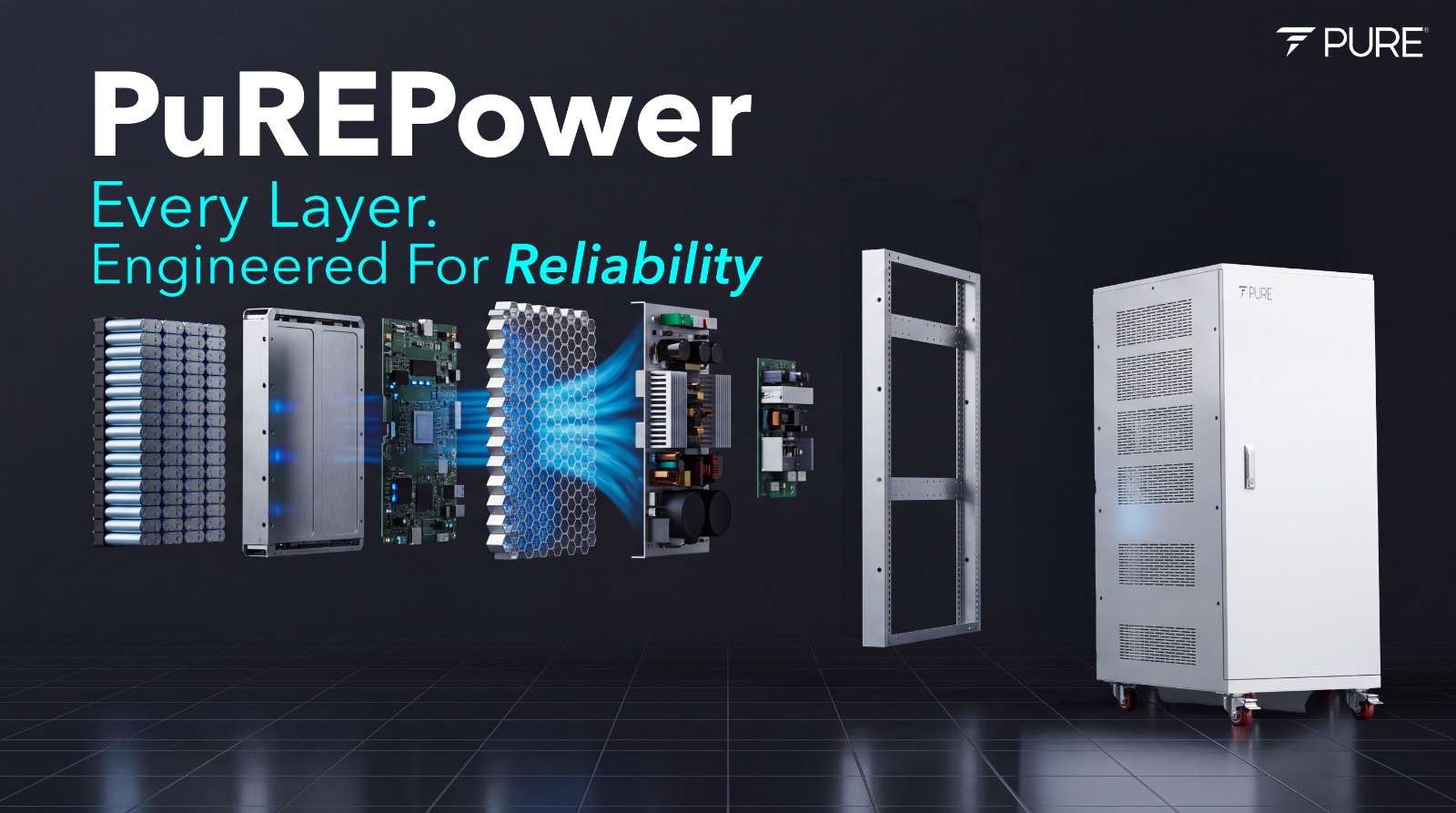
PuREPower manufactures complete BESS products, inverter, NMC battery pack, 5th Generation AI BMS, NPCM thermal management, DC protection, and safety enclosure, as unified, factory-tested systems. Every unit undergoes multiple charge-discharge cycles under simulated load before leaving the factory. Every internal connection is torque-verified. Every cell is matched within tight resistance tolerances. Every product carries a single, comprehensive warranty.
Our product range covers 3 kWh to 120 kWh, residential single-phase, residential and commercial three-phase, and large commercial and industrial capacities. The right product for your actual load and actual power cut profile is available as a complete, factory-certified system. No parallel battery juggling required.
PuREPower's product design team made a deliberate decision that directly reflects India's power cut reality: every product in the range maintains a 1:1 ratio between inverter capacity (kVA) and battery capacity (kWh). A 5 kVA inverter is paired with a 5 kWh battery. A 12 kVA inverter with 12 kWh. A 20 kVA inverter with 20 kWh.
This is not arbitrary. It is the product of three converging engineering and market insights:
Insight 1: It Matches India's Actual Power Cut Duration
At the rated inverter capacity (maximum connected load), a 1:1 system provides 1 hour of full-rated backup. At typical residential loads during a power cut, which are 40–60% of the inverter's rated capacity, because customers often don’t switch on all appliances at the same time, the same system provides 1.5–2.5 hours of backup. That covers the 45–60 minute median outage duration seen in Delhi DISCOM data, with significant headroom, for multiple consecutive cuts.
A customer who is offered a 5 kVA inverter with 20 kWh of site-assembled battery is being sold 4× the battery storage they statistically need, at 4× the risk of the failure modes described above. The 1:1 ratio is calibrated to the actual Indian market need, not to an extreme-case rural scenario.
Insight 2: 1C Discharge Rate Optimises NMC Battery Chemistry
The 1:1 ratio corresponds to a 1C discharge rate when the system is operating at full rated load, the battery discharges in 1 hour. NMC battery chemistry (which PuREPower uses exclusively) is specifically designed for optimal performance at 0.5C to 1.5C discharge rates. At 1C, NMC delivers peak energy density, maximum round-trip efficiency, and its full rated cycle life.
LFP chemistry is optimised for 0.3–0.5C. The 1:1 ratio, operating at 1C, is hard on LFP batteries and contributes significantly to the premature degradation seen in Indian LFP BESS installations. PuREPower's choice of NMC chemistry combined with the 1:1 ratio and NPCM thermal management is an engineered system optimised for Indian load profiles.
Insight 3: Fixed Product Lines Enable Genuine Quality Control
By committing to fixed kVA:kWh ratios across a defined product range, PuREPower can deeply test each specific product configuration, build supply chain reliability for each variant, collect field performance data on a homogeneous installed base, and continuously improve each product based on that data. A company offering 'flexible configurations' is spread across hundreds of permutations, none of which can receive this depth of engineering attention. The customer pays the price for that fragmentation in the form of warranty gaps, inconsistent performance, and service ambiguity.
The desire for flexibility and expandability is understandable. But in battery storage, flexibility at the installation level transfers engineering challenges from a factory with controlled processes and validated tools to a site with an electrician, a crimping tool, and no testing equipment, with DC voltages, fault currents, and electrochemical dynamics that require engineering precision to manage safely.
For most of India's 90%+ of customers experiencing short, frequent cuts rather than long single-instance outages: the right answer is a compact, correctly-sized, factory-integrated system that handles every cut with complete reliability. For the minority with genuinely large backup requirements: PuREPower's range goes to 120 kWh, all factory-made, all tested, all warranted.
Fifteen minutes of honest load assessment with a PuREPower-trained dealer identifies the right product. That conversation is worth more than any configuration-flexibility promise.
Q: Can I pair any inverter with multiple battery packs assembled on-site?
A: Technically possible, but not recommended by established BESS manufacturers. Site-assembled parallel battery configurations have unmatched cell resistances, lack factory DC protection, require a separately-configured BMU for inter-battery communication, and create physical safety risks from exposed terminals. Established brands sell fixed-specification factory-integrated products precisely to avoid these failure modes.
Q: What is the difference between a 5 kW inverter with 4 batteries and a factory 20 kWh system?
A: A factory-integrated 20 kWh BESS has cells matched for resistance before assembly, a BMS co-developed with the inverter, integrated thermal management, built-in DC protection, and an IP-rated safety enclosure. A 5 kW inverter paired with 4 on-site batteries has none of these, components from different production batches, no thermal management, and typically inadequate DC protection. The nameplate capacity may look similar; the engineering quality and real-world reliability are fundamentally different.
Q: What is a BMU and is it needed for parallel batteries?
A: A Battery Management Unit (BMU) aggregates communication from multiple individual battery BMS units, enabling coordinated cell balancing, accurate SoC estimation, and coordinated thermal protection across a parallel bank. Without a correctly configured BMU, parallel batteries are only electrically connected, there is no coordination of their internal management. The BMU is non-optional in a properly engineered parallel battery system and adds significant cost that is rarely included in site-assembly quotations.
Q: Why are DC-rated MCBs/MCCBs needed for a battery bank? Can I use normal AC MCBs?
A: No. Standard AC MCBs cannot reliably interrupt DC fault currents. AC arcs extinguish at current zero crossings (100 times per second); DC arcs at battery voltage are self-sustaining and will burn continuously if the protective device fails to trip. DC-rated MCBs and MCCBs have enhanced arc suppression mechanisms specifically designed for DC fault conditions. Using AC MCBs on a battery bank's DC protection circuit is one of the most common causes of catastrophic battery fires in Indian site-assembled installations.
Q: How long do power cuts typically last in Indian cities?
A: In over 90% of Indian urban and semi-urban locations, single-instance power cuts last 15–45 minutes. Multiple such cuts may occur throughout the day due to load shedding, feeder maintenance, or peak demand events. Extended single-instance cuts of 2–3 hours are typical only in rural areas and specific poorly-served urban feeders. For most Indian homes, 3–7 kWh of correctly-sized integrated battery storage handles every realistic power cut scenario.
Q: Do I really need 20 kWh of battery for my home backup in India?
A: For most Indian urban and semi-urban homes experiencing cuts of 15–45 minutes: no. A home drawing 2–3 kW average load needs only 1.5–2.5 kWh of usable battery to cover a 45-minute cut. A 5–7 kWh factory-integrated system comfortably covers even multiple back-to-back cuts with solar recharging in between. Large battery banks of 15–20 kWh make sense for specific scenarios: very long single-instance cuts, very high loads, off-grid applications, or significant solar self-consumption goals.
Q: Why does PuREPower not offer flexible or customisable battery configurations?
A: PuREPower's position is that quality, safety, and performance of a BESS cannot be maintained in a site-assembled configuration. Cell matching, BMS integration, DC protection, thermal management, and physical safety can only be properly engineered in a factory. Offering site-configured options would mean accepting outcomes PuREPower cannot control or warrant. Our product range from 3 kWh to 120 kWh provides the right flexibility at the product selection stage, not the installation stage.
Q: Is it safe to keep batteries on the floor at home?
A: No. Floor placement exposes batteries to dust on terminals, water spillage, rodent access to cables, and unimpeded contact by children. Best practice is wall-mounted installation in an IP-rated enclosed cabinet, away from living areas. PuREPower factory-integrated systems come in sealed, ventilated enclosures with no externally accessible live terminals, eliminating these risks by design.
Q: What happens to my warranty if I add an external battery to my BESS?
A: Any modification to a factory-integrated BESS, including connecting external battery packs in parallel, voids the manufacturer's warranty. This is standard practice across all established BESS OEMs globally. The warranty covers only the factory-designed and factory-tested configuration. Post-modification failures are not covered, and the modified configuration is unlikely to be covered by property fire insurance either.
Q: How do I find the right battery size for my home without over-buying?
A: A 15-minute load assessment with a PuREPower-trained dealer will calculate your peak loads, daily energy consumption, and average power cut duration in your specific location. This identifies the minimum correctly-sized integrated system for your needs, neither over-specified nor under-powered. For most Indian urban homes, PuREPower's 3–7 kWh range handles the actual power cut reality completely. Larger systems are available for specific high-load or extended-backup requirements.


 Call Now
  PuREPower Dealership
  PuREPower Enquiry Now