
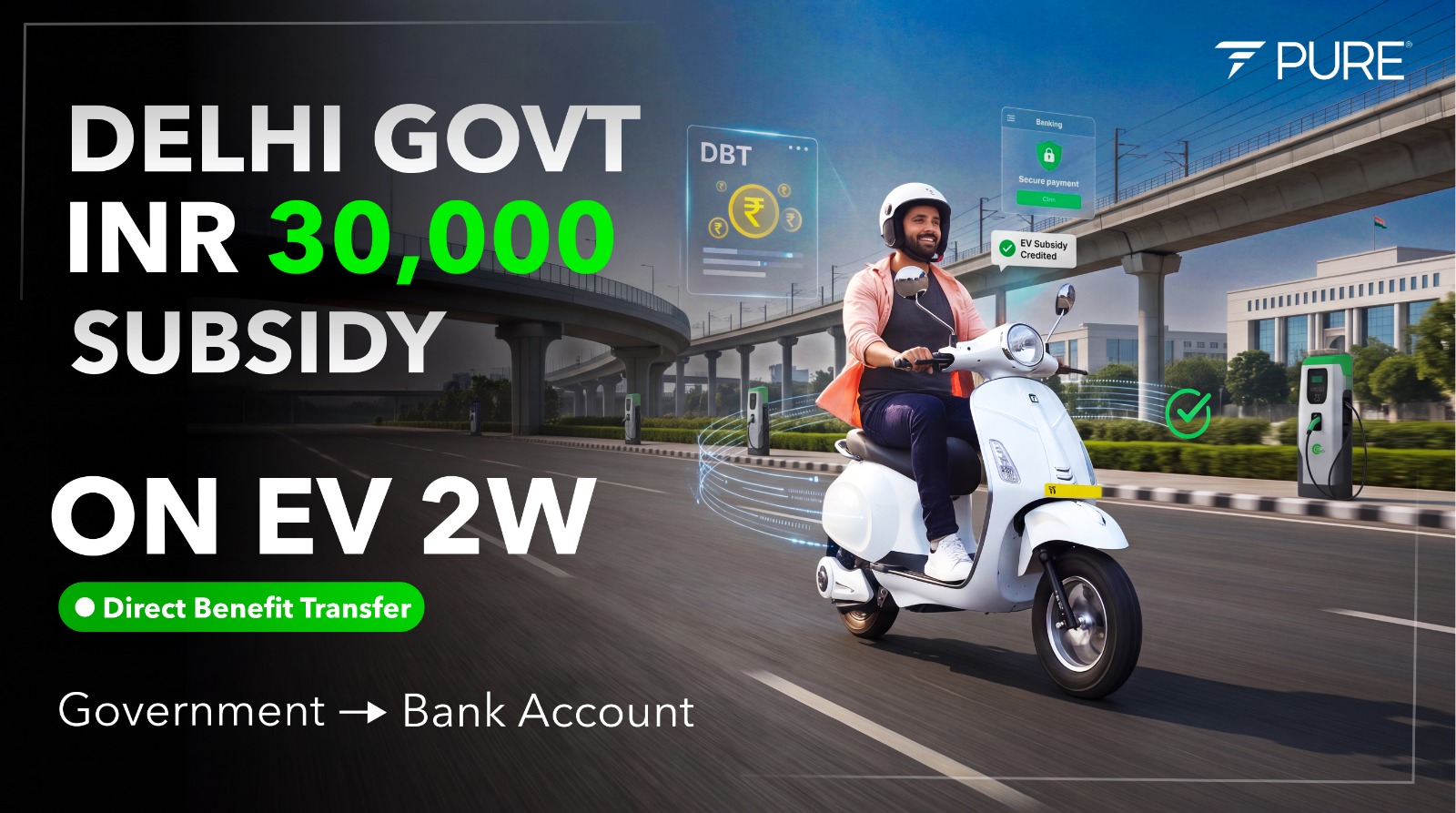
Quick answer: Under the Delhi Electric Vehicle Policy 2026 (notified 30 June 2026, effective 1 July 2026), buyers of electric two-wheelers registered in NCT of Delhi in Year 1 get a purchase incentive of ₹10,000 per kWh of battery capacity, capped at ₹30,000, plus a 100% lifetime road tax and registration fee waiver. The subsidy is disbursed as a Direct Benefit Transfer (DBT) straight into the buyer's own bank account after RC registration, not routed through the dealer or manufacturer. For PURE EV's four flagship scooters, that works out to ₹18,000 for the ePluto 7G CX, ₹18,000 for the eTRANCE NEO SX, ₹30,000 for the ePluto 7G PRO, and ₹30,000 (capped) for the ePluto 7G MAX.
If you commute in Delhi, run a delivery fleet, or are simply tired of watching petrol prices eat into your monthly budget, 1 July 2026 is a date worth remembering. That's when the Delhi Electric Vehicle Policy 2026 came into force, replacing the earlier EV Policy and resetting the incentive structure for every category of electric vehicle in the National Capital Territory: cars, three-wheelers, goods carriers, buses, and most importantly for the average household, electric two-wheelers.
Two-wheelers aren't a small slice of Delhi's vehicle problem; they are the problem in volume terms. According to the Commission for Air Quality Management's own submission to the Supreme Court, two-wheelers make up roughly 67% of Delhi's total vehicle stock, and vehicular emissions are the single largest contributor to the city's winter air pollution, at 23%. That single statistic explains why the new policy leans so heavily on two-wheeler electrification, going as far as mandating that only electric two-wheelers will be permitted for new registration in Delhi from 1 April 2028.
This article breaks down exactly what the Delhi EV Policy 2026 means if you're shopping for an electric scooter, whether for personal commuting, food and parcel delivery, or running a small fleet, and maps the Year 1 subsidy directly onto four PURE EV scooters: the ePluto 7G CX, eTRANCE NEO SX, ePluto 7G MAX, and ePluto 7G PRO.
Most conversations about EV subsidies in India focus on the rupee amount. That misses the more important structural change in Delhi's 2026 policy, and it's worth sitting with this before you look at any numbers.
Clause 4.1.1 of the Delhi Electric Vehicles Policy, 2026 states that "all purchase incentive under this policy shall be disbursed through direct benefit transfer to individual buyer/proprietary firms/agencies/companies" who are residents of NCT of Delhi, with the vehicle purchased and registered in Delhi. The buyer applies directly through a digital portal notified by the Transport Department, within 30 days of the Registration Certificate (RC) being generated, and the government disburses the eligible amount within 60 days of that application, subject to verification.
Why does this matter so much? In several other state EV subsidy schemes, the incentive is first extended to the OEM or dealer as an upfront discount, and the company then claims reimbursement from the government later. On paper this sounds convenient for the customer: you simply pay a lower on-road price. In practice, it has created real problems across the industry: subsidy claims getting stuck in bureaucratic backlogs, OEMs facing delayed government reimbursements, and, in the worst cases, companies passing that uncertainty back onto customers through price adjustments, withdrawn "discounts," or disputes months after the sale.
Delhi's DBT-first model removes the middleman entirely for the customer's slice of the incentive. You buy the scooter, get it registered with your local RTO in Delhi, apply on the government portal, and the money lands in your own bank account, the same account you use for salary, rent, or business banking. The manufacturer's cash flow, subsidy backlog, or claim-processing timelines have no bearing on whether you get paid. For a buyer, this is the difference between a subsidy that is a government promise to a company on your behalf, and a subsidy that is a government payment to you, full stop.
For small business owners and delivery fleet operators, who often finance two-wheelers on tight monthly cash cycles, that reliability is not a footnote. It is arguably the single most valuable feature of the policy, more valuable in practice than the headline rupee figure.
Beyond the purchase incentive, the policy bundles in several other benefits specific to two-wheelers:
Eligibility cap. The scooter's ex-showroom price must not exceed ₹2.25 lakh. Every mainstream PURE EV scooter, including the four models covered here, comfortably qualifies.
Year-wise purchase incentive. The incentive tapers as the policy matures, rewarding early adopters:
|
Year 1 from date of notification |
₹10,000 per kWh, up to a maximum of ₹30,000 |
|
Year 2 from date of notification |
₹6,600 per kWh, up to a maximum of ₹20,000 |
|
Year 3 from date of notification |
₹3,300 per kWh, up to a maximum of ₹10,000 |
This incentive applies to both plug-in charging and battery-swapping electric two-wheelers.
100% road tax and registration fee exemption. This is granted for the entire life of the vehicle, at the time of registration, a saving that continues well beyond Year 1 and adds up meaningfully over a scooter's ownership life.
Scrapping incentive. If you scrap a Delhi-registered BS-IV or older petrol two-wheeler at an authorised facility and buy a new electric two-wheeler within six months of receiving the Certificate of Deposit (CoD), you get an additional ₹10,000, also via direct benefit transfer to your bank account.
Electrification mandate on the horizon. From 1 April 2028, only electric two-wheelers can be newly registered in Delhi. If you're weighing "should I switch now or later," the direction of policy travel is unambiguous.
Digital, paperless implementation. Clause 9 of the policy commits the government to running applications, approvals, verifications, disbursements, and grievance redressal entirely through digital systems, reinforcing the intent to keep the process transparent and trackable for the applicant.
Subsidies grab headlines, but for anyone using a scooter commercially: food delivery, parcel logistics, last-mile fleets, or a small business running errands across the city, the bigger financial story is the running cost per kilometre, and this is where electric two-wheelers pull decisively ahead of petrol scooters.
A typical petrol scooter in Delhi returns somewhere between 45–55 km per litre. At current Delhi petrol prices, that puts fuel cost in the range of ₹1.9–₹2.3 per km. An electric scooter running on domestic electricity tariffs typically costs somewhere between ₹0.15–₹0.30 per km to charge, a fuel cost reduction of roughly 85–90% per kilometre travelled.
Run the numbers on a commercial rider covering 60–100 km a day, which is common for food and grocery delivery partners in Delhi. Over a 26-day working month, that's 1,560–2,600 km. At the petrol-cost-differential alone, that rider saves somewhere between ₹2,600 and ₹5,000 every single month just on fuel, before even accounting for lower maintenance costs, since electric scooters have far fewer moving parts (no engine oil changes, no clutch, no exhaust system, no spark plugs) and correspondingly lower service bills over the vehicle's life.
PURE EV's own usage data reinforces why this matters at scale: 76% of PURE EV customers have driven more than 30,000 km, and the company's most active riders are logging 40+ km per customer per day, with many customers crossing 40,000 km in 24–30 months. PURE EV vehicles collectively have covered over 300 crore kilometres on Indian roads. For a business owner deciding which scooter to put into a delivery fleet, that is a meaningful proof point: these aren't scooters built for occasional weekend use; they're built for, and are already being used for, high-mileage commercial duty cycles.
Add Delhi's road tax and registration fee waiver (which applies regardless of whether the buyer is an individual, proprietorship, or company, per Clause 4.1.1) and the lifetime cost advantage for a Delhi-based delivery business becomes substantial: lower purchase price after subsidy, lower fuel cost per km, lower maintenance, zero road tax, and, thanks to the DBT model, no risk of the subsidy being tied up in a corporate reimbursement queue.
Here's how the Delhi EV Policy 2026's Year 1 incentive (₹10,000 per kWh, capped at ₹30,000) applies to four PURE EV models, based on each scooter's certified battery capacity.
|
Model |
Battery |
Speed |
Mileage |
Price |
Subsidy |
|
ePluto 7G CX |
1.8 kWh Li-ion |
47 km/h |
85–101 km |
~₹80,799 |
₹18,000 (1.8 kWh × ₹10,000) |
|
eTRANCE NEO SX |
1.8 kWh Li-ion |
47 km/h |
85–101 km |
~₹73,999 |
₹18,000 (1.8 kWh × ₹10,000) |
|
ePluto 7G PRO |
3.0 kWh Li-ion |
60 km/h |
105–171 km |
₹1,12,279 |
₹30,000 (3 kWh × ₹10,000, exactly at cap) |
|
ePluto 7G MAX |
3.5 kWh Li-ion |
60 km/h |
120–211 km |
₹1,23,948 |
₹30,000 (capped: 3.5 kWh × ₹10,000 = ₹35,000, subsidy caps at ₹30,000) |
*Ex-showroom prices exclude accessories, handling, and other incidental charges, and are subject to change; always confirm current pricing with your nearest PURE EV dealership before booking.
All four models sit comfortably under the ₹2.25 lakh ex-showroom eligibility ceiling, so every one of them qualifies for the full Year-1 benefit. On top of the purchase incentive shown above, every buyer also receives the 100% road tax and registration fee waiver, and, if you're scrapping an old BS-IV or older petrol two-wheeler registered in Delhi, a further ₹10,000 scrapping incentive.
ePluto 7G CX: The Value Entry Point
The CX is positioned as PURE EV's accessible entry into the ePluto 7G family, built on the 1.8 kWh battery platform shared with the eTRANCE NEO SX. It's aimed at riders who want dependable daily commuting range (up to 101 km) without stepping up to a larger, pricier battery pack. With an ₹18,000 Year 1 Delhi subsidy plus the road tax waiver, the effective on-road cost drops meaningfully below the sticker price.
eTRANCE NEO SX: High Mileage, Compact Footprint
The eTRANCE NEO SX shares the same 1.8 kWh battery and mileage band as the CX but wears PURE EV's ETRANCE styling and platform, appealing to riders who want the brand's high-mileage positioning in a distinct design. It qualifies for the same ₹18,000 Year 1 incentive and is one of the more affordable ways to get into a PURE EV scooter with Delhi's subsidy factored in.
ePluto 7G PRO: The Sweet Spot for Range and Subsidy Efficiency
At exactly 3 kWh, the 7G PRO lands precisely at the ₹30,000 subsidy cap, meaning every rupee of its battery capacity is being converted into incentive value with no "waste" the way a larger pack would see. With a claimed range of up to 171 km and a 60 km/h top speed, it's a strong option for riders who need genuine day-long range, whether for longer commutes or delivery routes, while capturing the maximum Year 1 government benefit.
ePluto 7G MAX: Maximum Range, Maximum Comfort
The flagship of the lineup, the 7G MAX carries a 3.5 kWh battery for a claimed range of up to 211 km, PURE EV's most efficient 92%-rated powertrain, hill-start and down-hill assist, coasting regeneration, and a 10-year/70,000 km extended warranty option. Because the subsidy caps at ₹30,000 regardless of the extra 0.5 kWh over the PRO, the MAX is best suited to riders and businesses who genuinely need the extended range and premium feature set, not just the largest possible subsidy.
Consider a Delhi-based delivery rider choosing between the ePluto 7G PRO and a comparable petrol scooter, each covering roughly 2,000 km a month.
- Upfront saving (Year 1): ₹30,000 purchase subsidy + road tax/registration fee waiver (typically several thousand rupees depending on ex-showroom price) + zero fuel-linked road tax for life.
- Running cost saving: At a conservative ₹1.75/km fuel-cost differential in the EV's favour, 2,000 km/month saves roughly ₹3,500/month, or ₹42,000 in the first year alone.
- Maintenance saving: Electric scooters typically cost 40–60% less to service annually than petrol scooters, given the absence of engine oil, spark plugs, clutch plates, and exhaust components.
Stack the ₹30,000 upfront subsidy with a year of fuel savings, and a rider or small fleet operator can realistically be looking at ₹70,000+ in combined first-year savings relative to a petrol equivalent, before maintenance savings are even added in.
Does the Delhi EV Policy 2026 subsidy for electric two-wheelers go to the customer or the dealer?
It goes directly to the customer (or proprietorship/company, if registered in that entity's name) via Direct Benefit Transfer to their own bank account, after the vehicle is registered with the local RTO in Delhi and the buyer applies on the government's digital portal. It is not routed through the dealership or manufacturer.
How much is the Year 1 electric two-wheeler subsidy in Delhi?
₹10,000 per kWh of battery capacity, capped at a maximum of ₹30,000 per vehicle, for two-wheelers registered in the first year from the policy's notification date.
Is there a price limit for electric scooters to qualify for the Delhi subsidy?
Yes. The ex-showroom price of the electric two-wheeler must not exceed ₹2.25 lakh.
How long does it take to receive the subsidy after buying an electric scooter in Delhi?
You must apply within 30 days of your Registration Certificate (RC) being generated. The government is required to disburse the eligible amount within 60 days of that application, subject to verification.
Do I still get road tax exemption on an electric scooter in Delhi?
Yes. All electric vehicles registered in NCT of Delhi during the policy period get a 100% exemption from road tax for the entire life of the vehicle, plus a one-time registration fee exemption.
Is there an extra incentive for scrapping my old petrol scooter?
Yes. Scrapping a Delhi-registered BS-IV or older two-wheeler and buying a new electric two-wheeler within six months of the scrapping facility issuing a Certificate of Deposit earns an additional ₹10,000, also via direct bank transfer.
Which PURE EV scooter gets the maximum Delhi subsidy?
Both the ePluto 7G PRO (3 kWh) and ePluto 7G MAX (3.5 kWh) qualify for the maximum Year 1 incentive of ₹30,000, since 3 kWh already reaches the subsidy cap.
Will petrol two-wheelers still be allowed to register in Delhi after this policy?
Only until 31 March 2028. From 1 April 2028, only electric two-wheelers will be permitted for new registration in the NCT of Delhi.
Delhi's EV Policy 2026 is generous on paper: up to ₹30,000 in Year 1 incentive, a lifetime road tax waiver, and an additional ₹10,000 for scrapping an old petrol two-wheeler. But its real innovation is procedural, not financial: by paying the subsidy straight to the buyer's bank account rather than routing it through the manufacturer, Delhi has removed the single biggest point of friction and delay that has plagued EV subsidy schemes elsewhere in India. Combine that policy design with the genuine running-cost economics of electric two-wheelers, verified by PURE EV's own fleet data of 300+ crore kilometres ridden and customers regularly crossing 30,000-40,000 km, and the case for switching, whether you're an individual commuter or running a Delhi-based delivery fleet, has rarely been this straightforward.
If you're evaluating which PURE EV scooter fits your commute or your business, the ePluto 7G CX and eTRANCE NEO SX offer an accessible entry point with a ₹18,000 Year 1 subsidy, while the ePluto 7G PRO and ePluto 7G MAX deliver the maximum ₹30,000 incentive alongside significantly longer range for higher-mileage riders and fleets. Reach out to your nearest PURE EV dealership to confirm current on-road pricing in Delhi and get your subsidy application process started as soon as your scooter is registered.
Prices, specifications, and subsidy figures are based on the Delhi Electric Vehicles Policy, 2026 (notified 30 June 2026) and PURE EV's published specifications, and are subject to change. Please verify current ex-showroom pricing and subsidy eligibility with your local PURE EV dealer and the Delhi Transport Department's official portal before purchase.


 Call Now
  PuREPower Dealership
  PuREPower Enquiry Now