
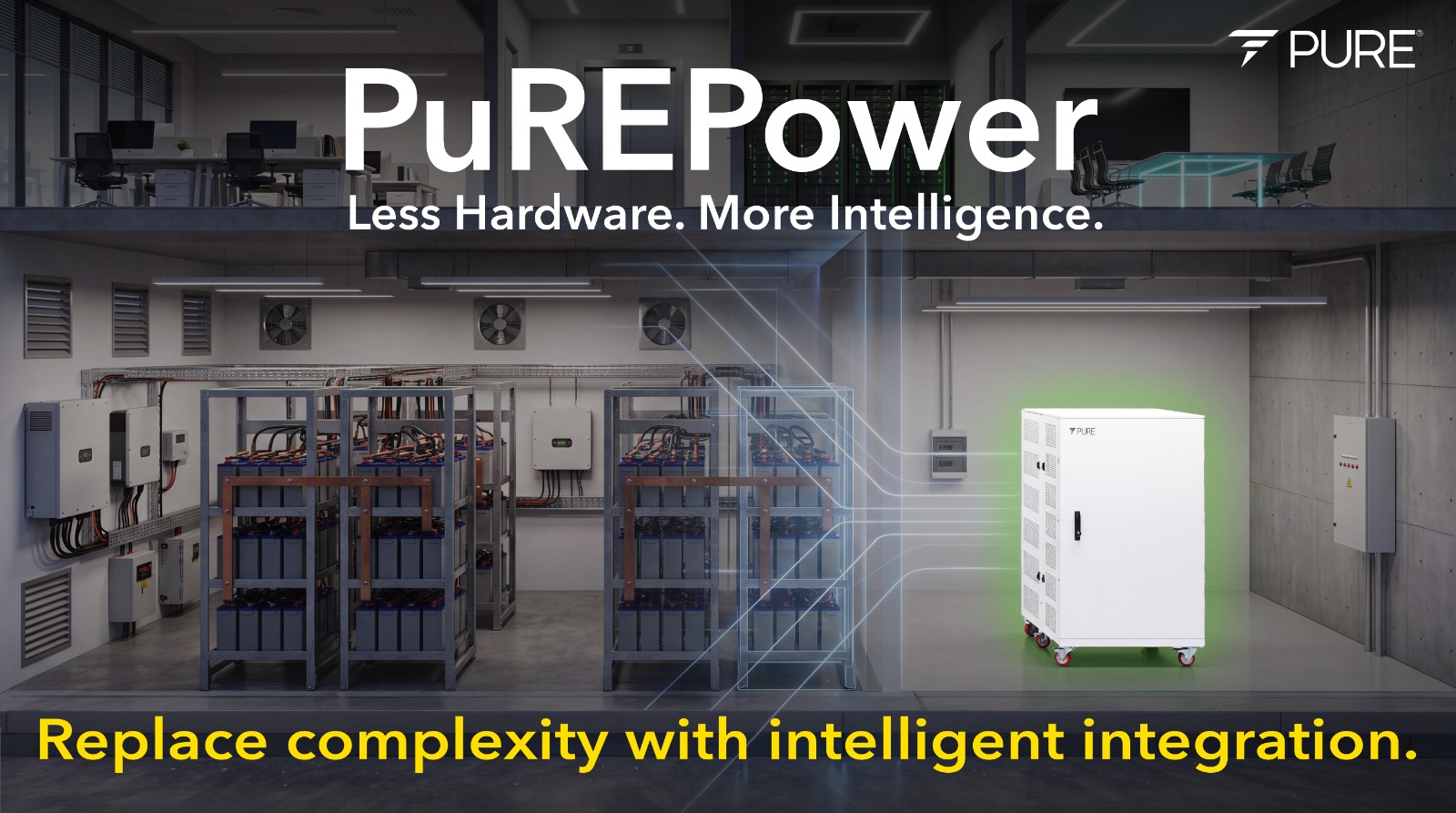
There is a familiar machine humming in the back of countless Indian offices, clinics and showrooms. It is the three-phase inverter, wired to a wall of squat black batteries in a ventilated room nobody likes to enter. For years it did an honest job. It kept the lights on, ran the fans and the computers, and bridged the short power cuts that punctuate the Indian working day.
But the building has grown up around it. There is a lift now. A second air-conditioner. A heavier printer, a few more workstations, perhaps a small production line or a cold-storage unit. The loads have changed, the power cuts have not gone away, and that faithful old inverter-plus-lead-acid setup is quietly buckling under demands it was never sized for. If yours trips when the lift moves, fades after twenty minutes, or sends you another bill for replacement batteries, this article is for you.
The honest truth is that the conventional inverter and lead-acid combination is yesterday's technology asked to do today's job. PuREPower 60.0 is the modern answer, and the gap between the two is wider than most business owners realise.
Look closely at a typical commercial backup setup and you will count three separate machines. There is an inverter, often around 80 kVA in three-phase form, converting battery power into usable AC. There is a bank of lead-acid batteries behind it, frequently something like 32 tubular cells of 200 Ah each, adding up to a nominal 64 kWh on paper. And, increasingly, there is a third box entirely: a separate grid-tied solar inverter on the roof, doing its own thing, blind to the battery and useless the moment the grid drops.
Three purchases. Three points of failure. Three things to service, monitor and eventually replace, none of which were designed to work as one system.
PuREPower 60.0 collapses all three into a single floor-standing cabinet.
|
The Old Way |
The PuREPower 60.0 way |
|
~80 kVA three-phase inverter |
Built-in 60 kVA three-phase inverter |
|
~64 kWh lead-acid bank (≈32 tubular cells) |
60 kWh advanced NMC lithium-ion, high usable capacity |
|
Separate grid-tied solar inverter |
Hybrid solar built in, keeps generating during a cut |
It is the inverter, the battery and the solar charger in one intelligent unit, engineered from the ground up to work together. One supplier, one warranty, one app, and far less to go wrong. Before we get to that, though, it is worth understanding exactly where the old setup lets you down, because the failures are not small.
Start with the number on the quotation, because it is the most misleading figure in the whole business. A lead-acid battery bank rated at 64 kWh does not give you 64 kWh of usable energy. It gives you roughly half that.
The reason is chemistry. Drain a lead-acid battery too deeply, too often, and you destroy it in months rather than years. To get any reasonable life out of the bank, you can only safely use about 50 percent of its capacity, a 50 percent depth of discharge. So that impressive-sounding 64 kWh shrinks, in real daily use, to something closer to 32 kWh of energy you can actually touch. You paid for a wall of batteries; you are allowed to use half of it.
Advanced lithium-ion plays by entirely different rules. PuREPower 60.0's 60 kWh of NMC lithium-ion is engineered for deep, daily cycling, so a far larger share of that nameplate capacity is genuinely usable, day in and day out. Put plainly: a lead-acid bank that looks bigger on paper can deliver less real backup than the 60.0, while taking up several times the space to do it. When you compare a lithium vs lead acid inverter battery setup honestly, you have to compare usable energy, not the sticker number, and on usable energy lithium wins comfortably.
Now the moment that exposes the weakness most cruelly: switch-on. Indian commercial loads are violent at the instant they start. A three-phase lift, a submersible pump, an air-conditioning compressor, a large motor, each can pull two to five times its normal running current for a fraction of a second as it kicks in. Engineers call it surge, or inrush.
A lead-acid bank hates surge. Its voltage sags hard under a sudden heavy draw, and the inverter in front of it, starved of stable voltage, stutters, trips or simply refuses to start the load. This is the exact reason so many businesses with a perfectly good inverter still cannot rely on it for the lift or the AC, and why they keep a diesel generator on standby anyway. The backup that cannot start your biggest loads is not really backup at all.
PuREPower 60.0 is built for precisely this. It is engineered to absorb roughly twice its rated load as surge, so lifts, compressors, pumps and motors start cleanly, without the nuisance trips and brownouts that plague a lead-acid setup. It delivers true three-phase power as a clean, pure sine wave, and it transfers from grid to battery in under four milliseconds, fast enough that sensitive electronics and machinery never register the cut. The work simply continues, even when the heaviest motor in the building chooses that exact moment to start.
That single capability quietly changes the economics of your whole site. If your backup can confidently start the lift and the air-conditioning, you no longer need a diesel generator idling outside as an expensive insurance policy for the loads your inverter cannot touch. The 60.0 does not just match the lead-acid setup on the easy loads, it covers the hard ones the old combination was never able to handle, which is exactly where most commercial buildings have been quietly compromising for years.
Here is the cost nobody mentions at the point of sale. Lead-acid batteries wear out. In Indian conditions, a tubular or VRLA bank typically lasts somewhere between three and five years before its capacity has faded so far that it needs replacing, and that is in reasonable conditions. Push it hard, run it hot, or discharge it deeply and that life shortens further.
Now think across a ten-year horizon. Over the life of a single modern lithium system, you would expect to buy, install and dispose of a lead-acid bank not once but three to five times over. Every few years: another big capital outlay, another installation, another stack of old batteries to handle responsibly, another disruption to your business. The "cheaper" option keeps sending you the bill, again and again, long after you thought the decision was made.
PuREPower 60.0 is built as a long-term asset, not a consumable. Its advanced NMC lithium-ion is engineered for well over a decade of dependable service, and it carries a warranty to match, five years as standard, extendable up to twelve. One purchase, one install, one system that is still working hard long after the lead-acid bank would have been junked and replaced several times. When you total the cost per usable kWh across the years, lead-acid is far more expensive than its low headline price suggests.
There is a hidden disruption cost, too. Every replacement is not just an invoice, it is a day of downtime, a contractor in the building, old cells to dispose of responsibly, and a fresh round of commissioning before you are protected again. Multiply that by three to five over a decade and the "budget" choice starts to look like a recurring tax on your time and your operations. A single lithium system you install once and largely forget is worth far more than the spreadsheet price alone admits.
There is a reason the lead-acid bank lives in its own room, and it is not a flattering one. Flooded lead-acid batteries need regular topping up with distilled water, a maintenance chore that someone has to remember every few months, across dozens of cells, or the bank degrades. As they charge, they release hydrogen gas, which is why that room must be ventilated and kept clear of ignition sources. And they hold acid, with all the handling, spillage and corrosion risk that implies.
So the conventional setup demands a dedicated, ventilated battery room: floor space surrendered, airflow engineered, a standing safety hazard tolerated, and a recurring maintenance task that is easy to neglect and expensive to get wrong. It is a surprising amount of fuss for a system that still cannot start your lift.
PuREPower 60.0 asks for almost none of it. It is a sealed, near-zero-maintenance lithium system, no water top-ups, no gassing to ventilate, no acid to handle. Its thermal management uses indigenous Nano Phase Change Material (Nano PCM), a passive, fireproof system that keeps the cells in their safe operating window without noisy liquid cooling or moving parts. And because it is an indoor-rated (IP21) cabinet running at under 50 decibels, it can sit cleanly in a utility area, a basement or a back office, no dedicated battery room, no ventilation project, no hazard sign on the door.
Two more practical problems round out the case against lead-acid, and both bite hardest in exactly the conditions Indian businesses face.
The first is sheer bulk. A 64 kWh lead-acid bank is heavy and physically enormous, dozens of cells on tiered racks, dominating a room. For the same usable energy, lithium is dramatically more compact and lighter, which is why the 60.0 fits the whole inverter-battery-solar function into one cabinet roughly the size of a large refrigerator, fitted with castor wheels so it can be positioned without a forklift and a civil works crew.
The second is heat. Lead-acid life is brutally sensitive to temperature; as a rough rule, every several degrees of sustained extra heat can roughly halve its service life. In an Indian summer, in an under-ventilated back room, that quietly shaves years off a bank that was already short-lived. It is a vicious circle: the room gets hotter, the batteries age faster, their capacity fades sooner, and the replacement cycle you were already dreading arrives even earlier than the brochure promised. The 60.0's Nano PCM thermal management is purpose-built to ride out those same brutal summers, holding the cells steady so the system keeps performing when the lead-acid alternative would be wilting and ageing fast.
Together, bulk and heat make the lead-acid bank a poor fit for the very buildings that need backup most, compact urban offices, busy clinics and tightly-packed MSME units where floor space is precious and the mercury climbs every April. You end up surrendering a room to a system that will still let you down in the heat. The 60.0 reverses that bargain: less space, more usable energy, and engineering that treats the Indian climate as the design brief rather than an inconvenient afterthought.
Finally, the leak you never see on a bill but pay for all the same: round-trip efficiency. Every time you store energy and draw it back out, some is lost as heat. A lead-acid system is typically only around 70 to 85 percent efficient on that round trip, so a meaningful slice of every unit you put in, whether from the grid or your solar panels, simply evaporates before it ever reaches your loads.
PuREPower 60.0 runs at around 94 percent round-trip efficiency. More of your solar generation and your cheap off-peak grid energy actually makes it through to do useful work, instead of being wasted as heat in an ageing battery bank. Over thousands of cycles across a decade, that efficiency gap compounds into a great deal of energy, and money, saved.
And because the 60.0 is a true hybrid system rather than three disconnected boxes, that efficient storage works hand in hand with built-in solar. Its solar charging is integrated, so surplus can be exported and stored energy can be scheduled with Time-of-Day and Time-of-Use logic, charging on cheap solar or off-peak power and running your business on it during expensive peak hours. The old separate grid-tied solar inverter could never coordinate with the battery like that; it just switched off the moment the grid did.
Stack it all up and the verdict writes itself. The conventional inverter-and-lead-acid setup gives you half the usable energy you paid for, sags when your biggest loads start, wears out and demands replacing several times over, needs a ventilated room and routine watering, takes up far more space, ages fast in the heat, and quietly wastes energy on every cycle. It was a fair solution for a simpler era. It is simply not enough for a modern commercial building.
PuREPower 60.0 answers every one of those failings, more usable lithium capacity, roughly twice the surge to start heavy loads, a ten-plus-year life, near-zero sealed maintenance, a compact indoor footprint, heat-ready Nano PCM thermal management, and around 94 percent efficiency, and folds the inverter, battery and solar into one intelligent, self-managing system you can watch from your phone. Lithium is the modern winner here, and it is not a close contest.
Still nursing an aging inverter and a room full of lead-acid? Talk to a PuREPower advisor or your nearest authorised dealer for a quick load assessment and a tailored plan to retire all three boxes for one.
| Item | PuREPower 60.0 | 80 kVA Inverter + 64 kWH Lead Acid Batteries + Solar Grid-Tied Inverter |
| Product Price (INR lakhs) | 17.32 | 15.86 |
| Continous Max Load (kW) | 60 | 60 |
| Battery Capacity (kWH) | 60 | 64 |
| Depth of Discharge | 95% | 80% |
| Usable Battery Capacity | 57 | 51.2 |
| Continous Max Load on Batteries/off- Grid (kW) | 60 | 18 |
| Loads It Can Power |
2x Three Phase Lift/elevator + 8 Tons Centralized |
Lights, Fans, Fridge, TV, Laptops, Desktops and Other Charging Ports |
| Surge Load Capability | 2X | 0.8 X |
| Switchover Time | Online (< 4> | No (for high surge loads) |
| Charging Time | 3 Hours | 5 to 10 Hours |
| Solar Integration | Yes | Yes |
| Bi-Directional | Yes | No |
| Solar Power Generation During Power-cut | Yes | No |
| TOD/ TOU | Yes | No |
| Auto DG sync | Yes | No |
| Battery Maintenance | ZERO | Distilled Water has to be filled in once in 6 months |
| Emissions | ZERO | H2SO4 (Risk: Corrosive to Skin, Eyes, and Respiratory passages) |
| Lifecycle / Lifespan | 10+ years | 5 years |
| Auto changeover | Inbuilt | Additional cost |
| Efficiency | 94% (Round-trip efficiency) | 80-85% (Lower efficiency) |
| Aesthetics | Suitable to All Interior Designs | Bulky |
| Space | Compact and requires lesser space than a refrigerator | Requires a separate battery room with Air Conditioning |
| Dimensions (mm) | 820×1155×1450 | 4,000 × 2,388 × 2,000 |
| Weight | 690KG | 2500 KG |
Q: Lithium vs lead acid inverter battery, which is better for a commercial office?
For a modern commercial office, advanced lithium-ion is clearly the better choice. A lead-acid bank gives only about half its rated capacity as usable energy, sags on surge loads like lifts and air-conditioners, and typically needs replacing every three to five years. Lithium delivers far more usable capacity, handles heavy startup surges, lasts well over a decade, needs almost no maintenance and runs at higher efficiency. PuREPower 60.0 goes further by combining the inverter, lithium battery and solar charger in one indoor cabinet, so you replace three ageing machines with a single, smarter system.
Q: Why does a 64 kWh lead-acid battery only give about 32 kWh of usable energy?
It comes down to depth of discharge. Draining a lead-acid battery deeply on a regular basis dramatically shortens its life, so you can only safely use about 50 percent of its rated capacity. That means a bank labelled 64 kWh delivers closer to 32 kWh of energy you can actually use day to day. Advanced lithium-ion such as the NMC cells in PuREPower 60.0 is built for deep, daily cycling, so a much larger share of its nameplate capacity is genuinely usable. The lesson is to always compare usable energy, not the headline number on the quotation.
Q: Can a lead-acid inverter system start a lift, AC or motor?
Often not reliably. Heavy three-phase loads pull two to five times their normal current for a split second when they start, and a lead-acid bank's voltage sags hard under that sudden draw. The inverter then stutters, trips, or refuses to start the load, which is why many businesses keep a diesel generator on standby despite owning an inverter. PuREPower 60.0 is engineered to absorb roughly twice its rated load as surge, so lifts, compressors, pumps and motors start cleanly, without nuisance trips or brownouts, on clean three-phase pure sine power.
Q: How often do lead-acid batteries need replacing compared with lithium?
In Indian conditions, a tubular or VRLA lead-acid bank typically lasts three to five years, and even less if it runs hot or is discharged deeply. Across a ten-year horizon you would expect to buy and install a fresh lead-acid bank three to five times over, each time with new capital cost, installation and disposal. Advanced NMC lithium-ion in PuREPower 60.0 is engineered for well over a decade of service and carries a warranty of five years standard, extendable up to twelve. One purchase replaces several rounds of lead-acid, which is why lithium's cost per usable kWh is far lower over time.
Q: What are the main problems with tubular batteries?
Tubular lead-acid batteries share the familiar lead-acid drawbacks. You can only use about half their rated capacity, they sag under surge loads, and they last only three to five years in Indian heat. Flooded types need regular distilled-water top-ups across many cells, they release hydrogen while charging so they need a ventilated room, and they contain acid with its handling and corrosion risks. They are also heavy and bulky. PuREPower 60.0 sidesteps all of this with a sealed, near-zero-maintenance lithium design that needs no watering, no ventilation project and no dedicated battery room.
Q: Do lithium battery systems really need less maintenance?
Yes, dramatically less. A flooded lead-acid bank needs distilled-water top-ups every few months across dozens of cells, ventilation to clear the hydrogen it gives off while charging, and careful handling of acid and corrosion. PuREPower 60.0 is a sealed lithium system with none of those chores, no watering, no gassing, no acid. Its Nano PCM thermal management is passive and fireproof with no liquid cooling or moving parts to wear out, and its 5th-generation smart BMS monitors the pack automatically, pushing alerts to the PuREPower app. For a busy business, that means backup you can largely forget about.
Q: How much space can I save by switching from lead-acid to lithium?
A great deal. A 64 kWh lead-acid bank is physically enormous and heavy, with dozens of cells on tiered racks dominating a dedicated, ventilated room. PuREPower 60.0 fits the same backup function, plus the inverter and a solar charger, into a single floor-standing cabinet roughly the size of a large refrigerator, fitted with castor wheels for easy positioning. Because it is indoor-rated (IP21) and runs at under 50 decibels, it does not need a separate battery room at all. You reclaim floor space while gaining more usable energy and far more capability.
Q: Does heat affect lead-acid batteries more than lithium?
Lead-acid life is very sensitive to temperature. As a rough rule, every several degrees of sustained extra heat can roughly halve its service life, so an Indian summer in an under-ventilated back room quietly strips years off a bank that was already short-lived. PuREPower 60.0 is built for exactly these conditions. Its indigenous Nano PCM thermal management passively keeps the cells in their safe operating window through demanding heat and surge events, so the system keeps performing reliably when a lead-acid alternative would be fading fast. It is engineering designed around the Indian climate, not in spite of it.
Q: Is a lithium inverter system more efficient than lead-acid?
Yes. Round-trip efficiency measures how much of the energy you store you actually get back. Lead-acid systems are typically only around 70 to 85 percent efficient, so a meaningful share of every unit from the grid or your solar panels is lost as heat before it reaches your loads. PuREPower 60.0 runs at around 94 percent round-trip efficiency, so far more of your solar and cheap off-peak energy does useful work. Across thousands of cycles over a decade, that gap compounds into substantial energy and cost savings, on top of everything you save on replacements and maintenance.
Q: Can PuREPower 60.0 also handle my solar, or do I still need a separate solar inverter?
PuREPower 60.0 has solar built in, so you do not need a separate grid-tied solar inverter. It is a true hybrid system with integrated solar charging and bi-directional export, and crucially it keeps generating from solar even during a power cut, something a standalone grid-tied inverter cannot do, because it simply switches off when the grid drops. It also coordinates solar, battery and grid intelligently using Time-of-Day and Time-of-Use scheduling, charging on cheap solar or off-peak power and running your business on stored energy during expensive peak hours. Three boxes become one coordinated system.


 Call Now
  PuREPower Dealership
  PuREPower Enquiry Now