
Walk into almost any Indian home with power backup and you will find the same corner.
An inverter on the wall. A row of batteries on the floor, sometimes on a wooden stand, sometimes on a trolley. A solar charge controller added later. A tangle of cables between them, a few of them warm to the touch. Three products, often from three different brands, sold by one dealer and installed by another.
It works. Mostly. Until it does not.
When it fails, the inverter company blames the battery, the battery company blames the wiring and the solar installer blames both. The customer is left holding three warranty cards and no answers.
There is another way to build a backup system, and it is becoming the standard across the world: one factory-integrated box that contains the battery, the inverter, the solar controller and the intelligence that makes them work as one. In the industry, we call it an all-in-one battery energy storage system, or all-in-one BESS.
This guide compares the two approaches honestly, on the things that actually matter to you: cost, safety, space, performance, warranty and service.
QUICK ANSWER
An all-in-one BESS combines the lithium battery, hybrid inverter, solar MPPT charge controller and battery management system in one unit that is designed, wired and tested together in the factory. Compared with a separate inverter, battery bank and solar controller, it is safer, more compact, faster to install, easier to monitor and backed by a single warranty. A separate setup can make sense when you already own a good inverter, but for a new system or an upgrade, all-in-one gives better long-term value.
A battery backup system, whatever its shape, has to do five jobs:
In a site-assembled system, these five jobs are spread across three or four separate products that meet for the first time at your premises. In an all-in-one BESS, they are engineered as one machine.
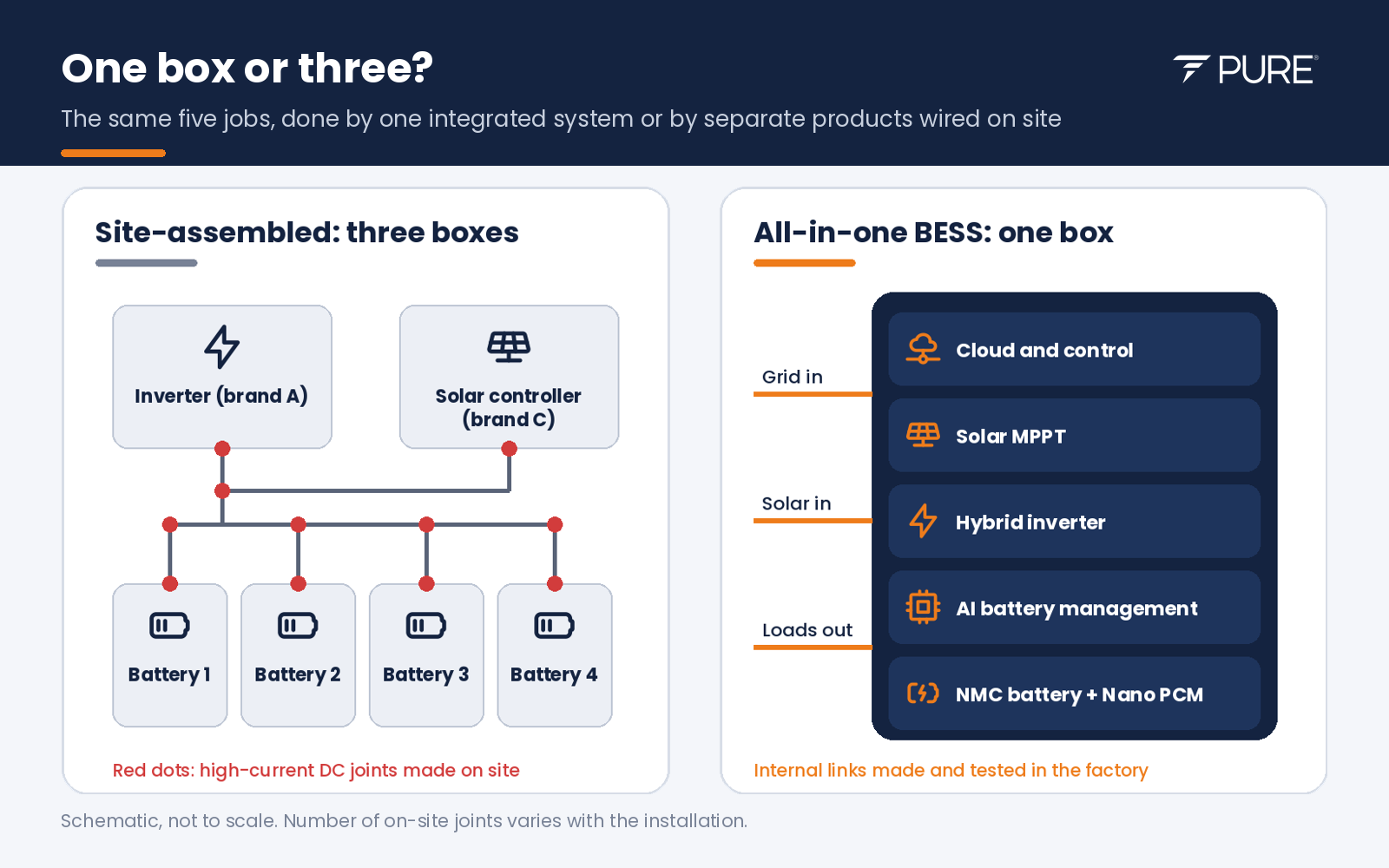 One box or three: the same five jobs, done by one integrated system or by separate products wired together on site
Most buyers compare backup systems on two numbers: kVA and price. That is understandable, and it is also how many people end up with the wrong system.
The real difference between the two approaches is not in any single component. It is in how well the components talk to each other.
In a well-designed all-in-one BESS, the BMS and the inverter share data continuously over an internal communication link. The inverter knows each cell's real state of charge, temperature and health, and adjusts how hard it charges or discharges in real time. If one cell group runs warm on a 45°C afternoon, the system can respond before there is a problem.
In a typical site-assembled setup, the inverter often has no idea what is happening inside the battery. Many inverters estimate charge from battery voltage alone, which is a rough guess at best. They charge using a fixed profile set at installation, often by a technician working from a generic table. Over months and years, that mismatch shortens battery life and, in the worst cases, creates real safety risks. We have written about this in more detail in why site-assembled battery configurations fail in India.
That is the honest truth of this comparison. You are not buying three boxes or one box. You are buying a level of integration.
Every cable joint, lug and terminal in a DC system is a place where heat can build up. A three-box setup has many more high-current DC connections, made on site, in conditions that are rarely ideal. An all-in-one system makes most of these connections inside the factory, under controlled torque and testing. Combined with a BMS that the inverter actually listens to, this removes the most common causes of overheating.
Indian loads are tough. AC compressors, pumps and motors draw a large surge when they start, and the grid itself swings in voltage. An integrated system is designed and tested as a whole for these conditions, including surge capacity and thermal behaviour at high ambient temperatures. In a site-assembled system, the weakest component sets the limit, and nobody has tested the combination you have just bought.
Every conversion and every metre of DC cable loses a little energy. An all-in-one design keeps DC paths short and is optimised as a single system. PuREPower's rated efficiency is about 97% for our single-phase home models and about 94% for our three-phase commercial range. With separate components, the overall efficiency depends on the weakest link and on how well the installer has matched them.
A three-box system usually needs a wall for the inverter, floor space for batteries, a separate box for the solar controller and room for cables. An all-in-one unit is a single cabinet with a clean front panel that fits in a utility area, a staircase corner or a shop's back room.
An all-in-one BESS arrives pre-configured. Installation is mostly about connecting the grid input, your load output and, if you have it, solar. That means fewer steps, fewer decisions left to the technician and less room for error. At PuREPower, connected systems also support automated installation and commissioning checks through our cloud platform, so the system confirms it has been installed correctly.
With separate products, you often get a separate app for each, or none at all. An all-in-one system gives you one view of everything: solar generation, battery health, load, grid status and alerts. PuREPower systems connected to Wi-Fi report to PURE Cloud, so our service team can see a problem before you do and many issues can be resolved remotely.
This is where most buyers feel the difference, usually years later. With three products, you deal with three warranties, three service networks and three sets of terms. With an all-in-one system, there is one warranty, one service number and one company responsible for the whole result. PuREPower systems come with a 5-year standard warranty, extendable up to 12 years.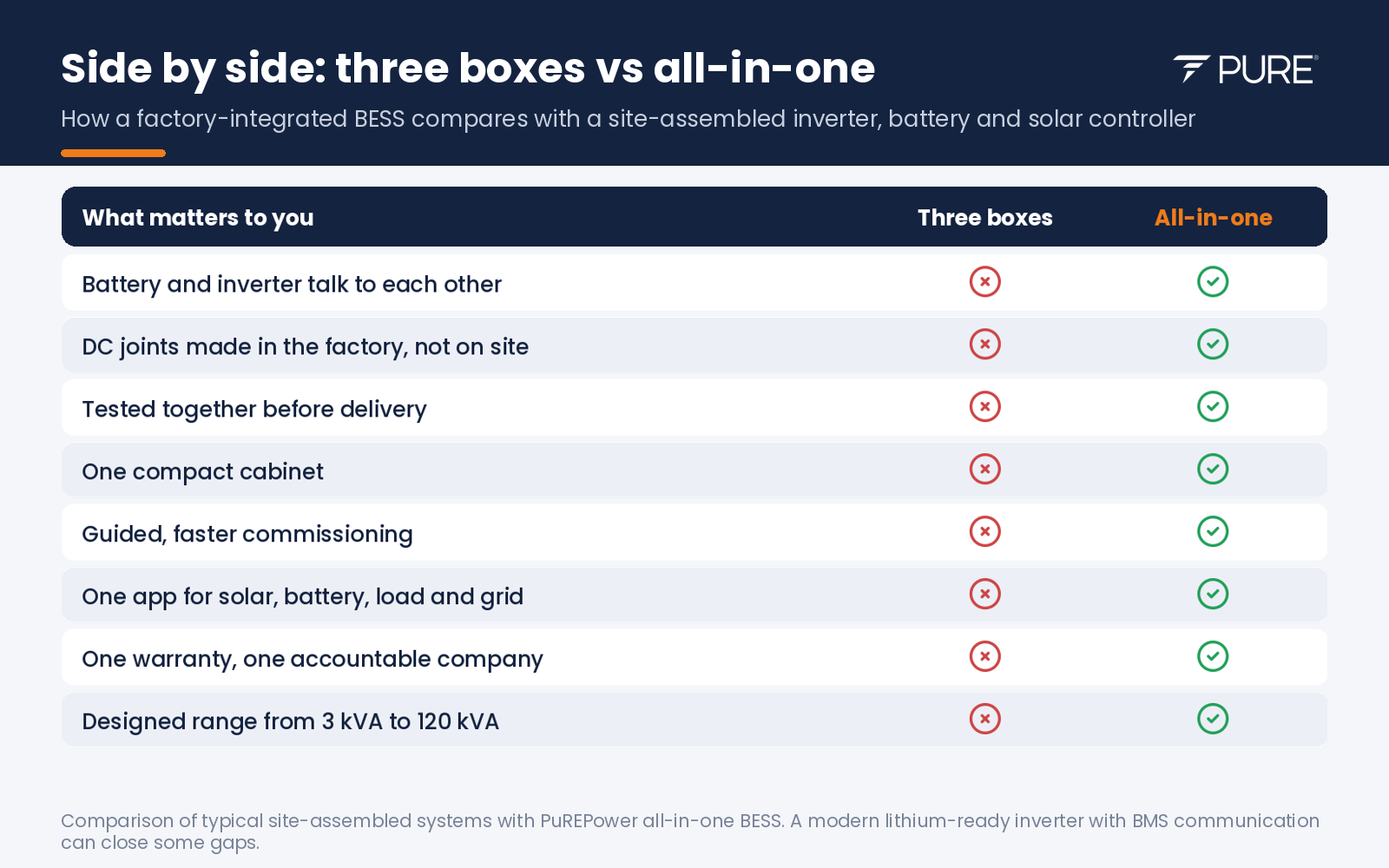 Side by side: how a factory-integrated all-in-one BESS compares with a site-assembled inverter, battery and solar controller
| What you should compare | Separate inverter + battery + solar controller | All-in-one BESS (PuREPower) |
|---|---|---|
| Battery and inverter communication | Often none; charge guessed from voltage | Continuous BMS to inverter link inside the unit |
| High-current DC joints made on site | Many | Very few; made and tested in the factory |
| Tested together before delivery | No; combination meets for the first time at site | Yes; the full system is factory tested |
| Space required | Wall + floor + controller + cable runs | One compact cabinet |
| Installation | Several products, more steps, more room for error | Pre-configured, faster, guided commissioning |
| Monitoring | Separate apps or none | One app and cloud view of the full system |
| Warranty and service | Two or three warranties, shared blame | One warranty, one accountable company |
| Upgrade path | Mix and match, compatibility not guaranteed | Designed range from 3 kVA to 120 kVA |
To be fair, there are cases where a separate setup is reasonable:
For everyone else, especially anyone buying a new system, replacing an ageing lead-acid setup or adding solar, all-in-one is the simpler and safer choice.
Here is where many buyers get confused, so let us be clear.
On the day of purchase, a basic inverter with a lead-acid battery bank can look cheaper. A lithium-based all-in-one system costs more upfront than the cheapest possible backup. But that comparison ignores what you pay over the life of the system: replacing lead-acid batteries every few years, topping up water, the energy lost in a less efficient system, the hours of downtime when one of three components fails and the service visits in between.
When you compare a lithium all-in-one BESS with a lithium battery bought separately and paired with a separate inverter and controller, the gap narrows sharply. And the all-in-one system gives you integration, safety and a single warranty on top.
The right question is not "Which is cheaper today?" It is "Which will cost me less, and trouble me less, over the next ten years?"
THE CORE INSIGHT
A backup system is only as good as the conversation between its battery and its inverter. In an all-in-one BESS, that conversation happens inside one box, designed by one team, tested in one factory and backed by one warranty. In a three-box setup, it often does not happen at all.
Whichever way you go, ask your dealer these questions:
A manufacturer of a true all-in-one system will answer all six without hesitation.
PuREPower is an all-in-one hybrid BESS, designed and built in India. Each unit combines high-density NMC cells, an indigenous Nano PCM thermal layer for passive heat management, a 5th generation AI-enabled BMS, a hybrid inverter, solar MPPT and cloud connectivity in one factory-tested system.
The range covers homes and businesses of every size: 3.0 Lite, 3.0, 5.0 and 12.0 in single phase, and 15.0 Lite, 20.0, 30.0, 60.0 and 120.0 in three phase, with multiple units combinable for larger sites. Every system is sized and commissioned to its nominal rating, 75% of the maximum power, so it runs cool and lasts.
For years, Indians have accepted that power backup means a corner full of boxes and cables, and a warranty card for each. That was never a choice. It was simply all that was available.
It is no longer the case. An all-in-one BESS does the same five jobs in one compact, factory-tested system, more safely, more efficiently and with one company standing behind the result.
One box or three? For a new system, the answer is one.
Tell us what you want to run during a power cut and for how long. A PuREPower advisor or your nearest authorised dealer will recommend the right all-in-one system for your home or business: www.pureenergy.co.in/enquiry-now
Everything you need to know about this topic.

 Call Now
 PuREPower Dealership
 PuREPower Enquiry Now