

A plain-English guide for Indian factories, hospitals, malls and commercial buildings on maximum demand, contract demand penalties and how an all-in-one BESS pays for itself
Your building can run perfectly for 29 days and still get a bill that punishes you for a few minutes.
It happens every summer. The chiller kicks in at 3 PM, both lifts are moving, the kitchen is running and someone switches on the second compressor. For one metering window, your demand jumps well above normal. Nobody notices. Nothing trips.
Then the bill arrives.
In most Indian states, commercial and industrial consumers on HT supply pay two kinds of charges. One is for the energy you used. The other is for the highest demand you touched. That second number, the maximum demand, is where a single spike can quietly cost you lakhs of rupees in a single month.
This article explains exactly how that happens, with real numbers from a published tariff order, and how a battery that shaves those peaks can turn a penalty into a payback.
QUICK ANSWER
Demand charges are billed on the highest demand your meter records in the month, usually with a floor of 75 to 85 percent of your contract demand. If you exceed your contract demand, many tariff orders charge the excess at twice the normal rate, and some add a surcharge on your entire month's energy. A battery energy storage system discharges during those peaks so the grid never sees them. That keeps your maximum demand below the limit, avoids penalties and can delay an expensive contract demand increase.
Think of your electricity bill the way you would think of a taxi fare. There is a charge for the distance you travel, and there is a charge for keeping the car reserved for you. Energy charges are the distance. Demand charges are the reservation.
Your DISCOM has to build and maintain transformers, cables and substations large enough for your highest demand, not your average demand. So it charges you for that capacity every month.
The technical review "Global Energy Storage Systems: A Critical Technical Review" by IIT Bombay's Grid Integration Lab, prepared under the MNRE and GIZ StoREin programme, puts it simply. For commercial and industrial users, demand charge reduction is a key driver of storage adoption, because demand charges constitute a significant share of total electricity costs.
Three terms decide how much you pay:
Let us use real, published numbers. We will take Telangana, where PuREPower is headquartered, because the tariff schedule is clear and public.
Under the Telangana retail supply tariff schedule for FY 2025-26, which TGERC has retained for FY 2026-27, an HT-II(A) commercial consumer at 11 kV pays:
And if the recorded maximum demand exceeds the contract demand, the schedule is strict:
| Recorded demand vs contract demand | Demand charge on the excess | Energy charge on the full month |
|---|---|---|
| 100 to 120 percent | 2 times the normal rate | Normal |
| Above 120 and up to 200 percent | 2 times the normal rate | 1.15 times the normal rate |
| Above 200 percent | 2 times the normal rate | 1.20 times the normal rate |
Read the last column again. Above 120 percent, the surcharge applies to your entire month's energy, not just to the minutes of the spike.
Now imagine a mid-sized hospital, office building or mall in Hyderabad with a contract demand of 200 kVA. On a normal month, its recorded maximum demand is about 180 kVA, and it uses about 55,000 units.
| Bill component (illustrative) | Normal month | Month with one spike to 245 kVA |
|---|---|---|
| Billing demand | 180 kVA | 200 kVA plus 45 kVA excess |
| Demand charge | ₹90,000 | ₹1,00,000 plus ₹45,000 on the excess at double rate |
| Energy surcharge (spike is 122.5 percent of CMD) | Nil | 15 percent on 55,000 units at ₹8.80, about ₹72,600 |
| Extra cost caused by one spike | None | About ₹1.28 lakh in a single month |
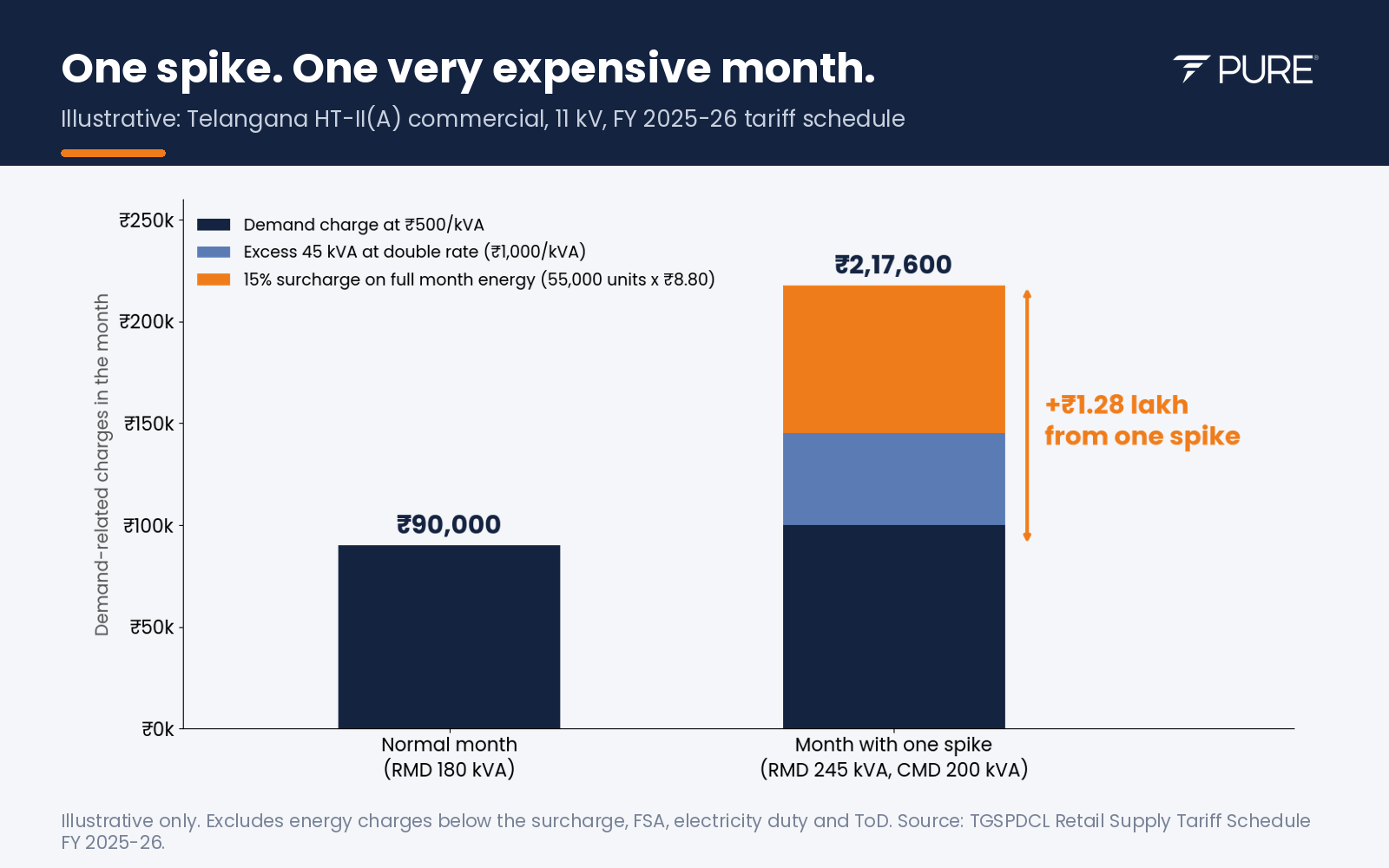
That is ₹1.28 lakh for a few minutes of bad timing. If it happens in three summer months, that is close to ₹4 lakh a year, before fuel surcharges, electricity duty or ToD charges are added.
These figures are illustrative. Your actual bill depends on your meter data, your category and the tariff order in force. But the structure is the same in most Indian states: demand is priced on your worst moment, and exceeding your contract is punished hard.
The usual advice is to increase your contract demand. It feels safe. It is often a costly habit.
Raise the contract demand from 200 kVA to 250 kVA and the 80 percent floor rises from 160 kVA to 200 kVA. In Telangana, that means you pay for at least 200 kVA every single month, even in winter, even when your real demand is far lower. You also typically pay additional security deposits and development charges, and in some cases you may need a transformer or cable upgrade.
In other words, you pay for your worst moment all year round.
There is a better way. Instead of buying more grid capacity for a spike that lasts minutes, you supply the spike yourself.
Peak shaving is simple in principle. A battery energy storage system sits between the grid and your load. When your demand rises above a set threshold, the battery discharges and supplies the difference. The grid never sees the peak. When demand falls, the battery recharges, ideally from solar or during cheaper hours.
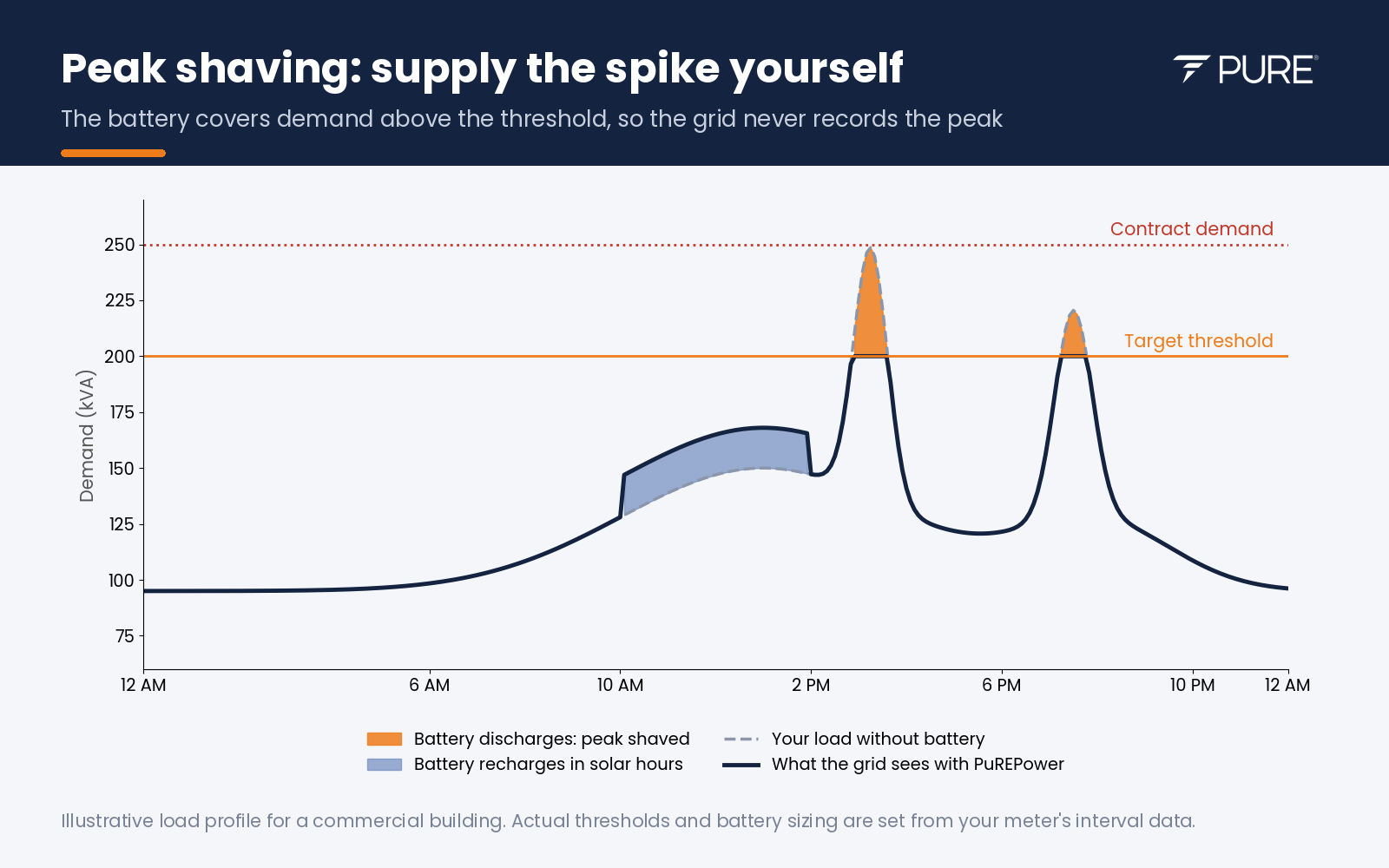
The IIT Bombay review describes peak shaving as an hours-scale service that can be stacked with faster services such as solar smoothing and voltage support, provided the battery's energy and power headroom are planned properly. That last condition is important, and it is where system design matters.
For demand charge management, a battery must do three things well:
This is exactly the duty cycle PuREPower was designed for. NMC chemistry delivers high power and surge capability in a compact footprint. The fifth generation BMS manages C-rate dynamically, and indigenous Nano PCM keeps cell temperatures stable during repeated high-power events without liquid cooling.
Peak shaving is a sizing exercise, not a guess. Here is how our team approaches it.
Most HT meters and many modern LT meters record demand in 15 or 30 minute intervals. Three to six months of this data, especially summer months, shows exactly when peaks occur, how high they go and how long they last.
Decide the maximum demand you want the grid to see. Usually this sits comfortably below your contract demand, leaving a safety margin.
The gap between your peak and your threshold decides the battery's power rating. We size against the Nominal Power of the system, which is 75 percent of its Maximum Power, and keep the Maximum and surge ratings as headroom for coincident peaks and motor starts. For example, PuREPower 60.0 has a maximum rating of 60 kW, a nominal rating of 45 kW, 60 kWh of storage and a surge rating of 120 kW. PuREPower 120.0 doubles that, with 90 kW nominal and 120 kWh.
Multiply the power you need to shave by the duration of your longest peak, then add a reserve for backup. A 45 kW shave for 30 minutes needs about 23 kWh. A 60 kWh system does that comfortably and still keeps energy in reserve for a power cut.
The system is configured to discharge above the threshold, recharge in low-demand or solar hours and hold a backup reserve. This is set during installation and commissioning and can be refined remotely through PURE Cloud AI as your load pattern changes.
The best part of peak shaving is that the same battery earns in more than one way. This is what the industry calls value stacking.
Take the Hyderabad example again. Demand penalty avoidance of around ₹3.8 lakh a year, plus ToD savings of roughly ₹36,000 a year on about 50 units shifted per day, gives more than ₹4 lakh a year from a single PuREPower 60.0, before counting diesel savings, backup value or the avoided contract increase. That is how a battery stops being an expense and starts being an asset. For a complete cost walk-through, see our PuREPower 60.0 ROI breakdown.
THE CORE INSIGHT
You do not need a bigger grid connection to handle a bigger peak. You need a smarter one. A battery that supplies your worst moments lets you pay for the capacity you actually use, every month, for years.
Not every business is on HT supply. Shops, clinics, small offices and workshops are usually on LT supply, where fixed charges are based on contracted load in kW rather than recorded kVA demand. In Telangana, for example, LT-II commercial fixed charges range from ₹30 to ₹100 per kW per month, and LT-III industry pays ₹100 per kW per month.
For LT businesses, the value of a battery is slightly different but just as real:
Peak shaving is a coordination problem. The battery, the inverter, the solar controller and the control software must agree, in milliseconds, on who supplies what. When these come from different vendors and are wired together on site, that coordination is the first thing to fail.
PuREPower integrates the NMC battery, the power conversion system, solar MPPT, protection and AI control in one factory-built, factory-tested unit. One system, one warranty, one app and one number to call. Our range covers 3.0 to 12.0 in single phase and 15.0 Lite to 120.0 in three phase, and multiple units can be combined for larger sites.
Every commercial electricity bill in India hides a simple truth. You are not charged for your average day. You are charged for your worst moment.
Most businesses respond by buying more grid capacity and paying for it every month. The smarter response is to take control of the peak. A properly sized battery energy storage system caps your maximum demand, removes penalties, captures Time-of-Day savings, stores your solar and replaces your diesel generator during outages, all from one box.
The penalty you paid last summer is the first instalment on a battery you have not bought yet.
Send us your last three electricity bills or your meter's demand data. A PuREPower advisor or your nearest authorised dealer will map your peaks and share a free peak shaving and savings assessment: www.pureenergy.co.in/enquiry-now | Call 924 004 5993
Everything you need to know about this topic.


 Call Now
 PuREPower Dealership
 PuREPower Enquiry Now