
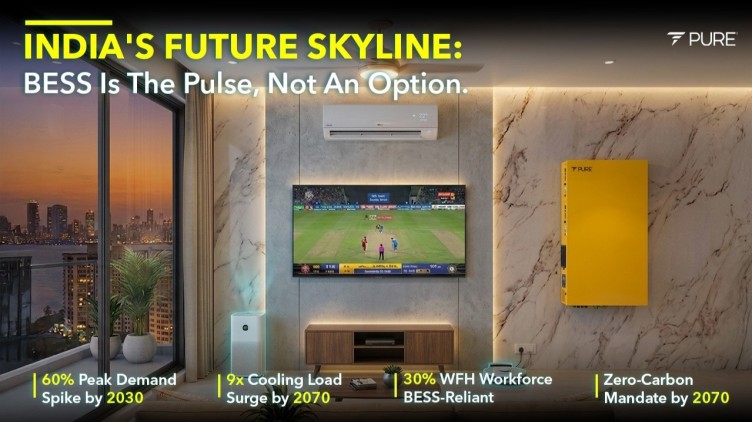
India is currently the most significant construction site on the planet. Every single year, the nation adds nearly one billion square metres of floor area—a staggering expansion that equates to building a new Chicago every twelve months. This is not merely a story of concrete, glass, and steel; it is a fundamental shift in the movement of electrons.
Crucially, 86% of the buildings that will exist in India in 2070 have not yet been built. This creates a historic, "built-in" market for energy resilience. By 2030, roughly 25% of the standing stock will be "new-age" construction, rising to approximately 45% by 2040. In this rapidly evolving landscape, Battery Energy Storage Systems (BESS) are shifting from an optional, high-end retrofit to a standard, "Day-1" requirement for any viable real estate project. As states like Maharashtra move toward making storage a condition of grid connectivity from April 2026, the era of treating backup power as an afterthought is officially over.
As temperatures rise and disposable incomes grow, the air conditioner (AC) has evolved from a luxury into the most disruptive appliance on the Indian grid. The sheer scale of this cooling surge is the primary engine behind the BESS revolution.
• The Demand Surge: India's residential cooling demand is forecasted to explode from 123 TWh in 2020 to a massive 834 TWh by 2070.
• The Stock Factor: The national inventory of air conditioners is expected to grow 10x by 2050, making the "AC + Battery" pairing the new standard household expectation.
• The Peak Pressure: India's peak electricity demand is expected to rise by 60% by 2030, reaching approximately 360 GW. By 2040, cooling-driven peaks will require BESS to mitigate nearly 150 GW of additional evening load.
This creates a structural paradox: the evening AC peak (typically 6:00 PM to 10:00 PM) occurs precisely when solar generation drops to zero. Without localized storage, this surge threatens to collapse the aging urban grid. BESS is the only viable way to manage these massive AC loads, ensuring that the comfort of a cooled home doesn't come at the cost of grid stability.
While residential demand remains the largest by volume—projected to hit ~850 TWh by 2040—the commercial segment is becoming more concentrated and power-intensive. Commercial electricity demand is set to increase by 3.7x to 4.2x by 2050, driven by high-intensity, 24/7 operations.
• The Data Center Factor: The rise of high-intensity, 24/7 data centers mandates large-scale BESS for green energy smoothing and mission-critical emergency backup.
• The Service Sector Shift: As work-from-home stabilizes for roughly 30% of the service sector by 2030, the demand for BESS units that offer unnoticeable power transitions will become a standard home-office requirement.
• Operational Continuity: For modern retail, hospitality, and healthcare, BESS has transitioned from an "energy insurance" product to a core operational requirement for business continuity.
By 2040, the commercial segment alone will demand ~450 TWh. In this high-stakes environment, localized storage ensures that commercial entities can maintain 100% uptime while transitioning away from carbon-intensive diesel generators.
The transition to storage is being accelerated by aggressive government mandates and international pressure to meet Net Zero Scenario (NZS) targets. This is no longer a distant aspiration; it is a near-term commercial mandate.
• PM Surya Ghar Scheme: With a target of 1 crore households by 2030, this scheme creates an immediate, government-backed market for BESS to store daytime solar energy for nighttime use.
• Mandatory Building Codes: By 2030, the Energy Conservation Building Code (ECBC) is expected to be mandatory for all large buildings. By 2040, "Net Zero" building certifications will require BESS for approval.
• Grid Deferral Economics: Utilities are increasingly relying on consumer-side storage to manage the load. By 2040, BESS growth is expected to help utilities defer an estimated $50+ billion in potential upgrades to aging urban transformers and distribution lines.
As domestic production of Lithium-ion and advanced chemistry batteries lowers costs, we are entering a price-parity boom with traditional inverters. The government-phased shift away from diesel-based backups toward BESS is now fiscally and logistically inevitable.
To meet this exponential demand, PuREPower provides a comprehensive 5 kW to 120 kW BESS range designed to serve every building segment in India’s future skyline.
• Residential Solutions (5–10 kW): For the rising share of HIG urban households (projected to hit 14% by 2070), PuREPower offers "Boss Mode" energy security, ensuring that AC loads and home offices never skip a beat.
• Apartments & Housing Societies (30–60 kW): Using advanced parallel unit technology, PuREPower can scale to meet the common-area and centralized storage needs of doubling urban populations as urbanization hits 65% by 2070.
• Commercial & Industrial (60–120 kW): For high-intensity commercial loads reaching ~330 TWh by 2040, PuREPower’s high-capacity units provide the green energy smoothing and heavy-load support required for modern infrastructure.
PuREPower systems are engineered for "Day-1" integration, allowing developers to meet mandatory ECSBC codes and Net Zero certifications without the complications of retrofitting older technology.
By 2030, energy independence will be a mainstream status symbol. In a digital-first, 24/7 economy, consumers are no longer content to be passive ratepayers; they want to "own their power." India's building boom is the perfect catalyst for this revolution.
With 86% of our future cities yet to be built, we have a one-time opportunity to build them right—with localized, intelligent storage at their heart. The "AC + Battery" era is here, and it is powered by PuREPower.
To learn how PuREPower’s "Day-1" BESS solutions can future-proof your next residential or commercial project and ensure compliance with 2030 Net Zero standards, visit Commercial & Industrial BESS Solutions | PURE Energy.


 Call Now
  PuREPower Dealership
  PuREPower Enquiry Now