
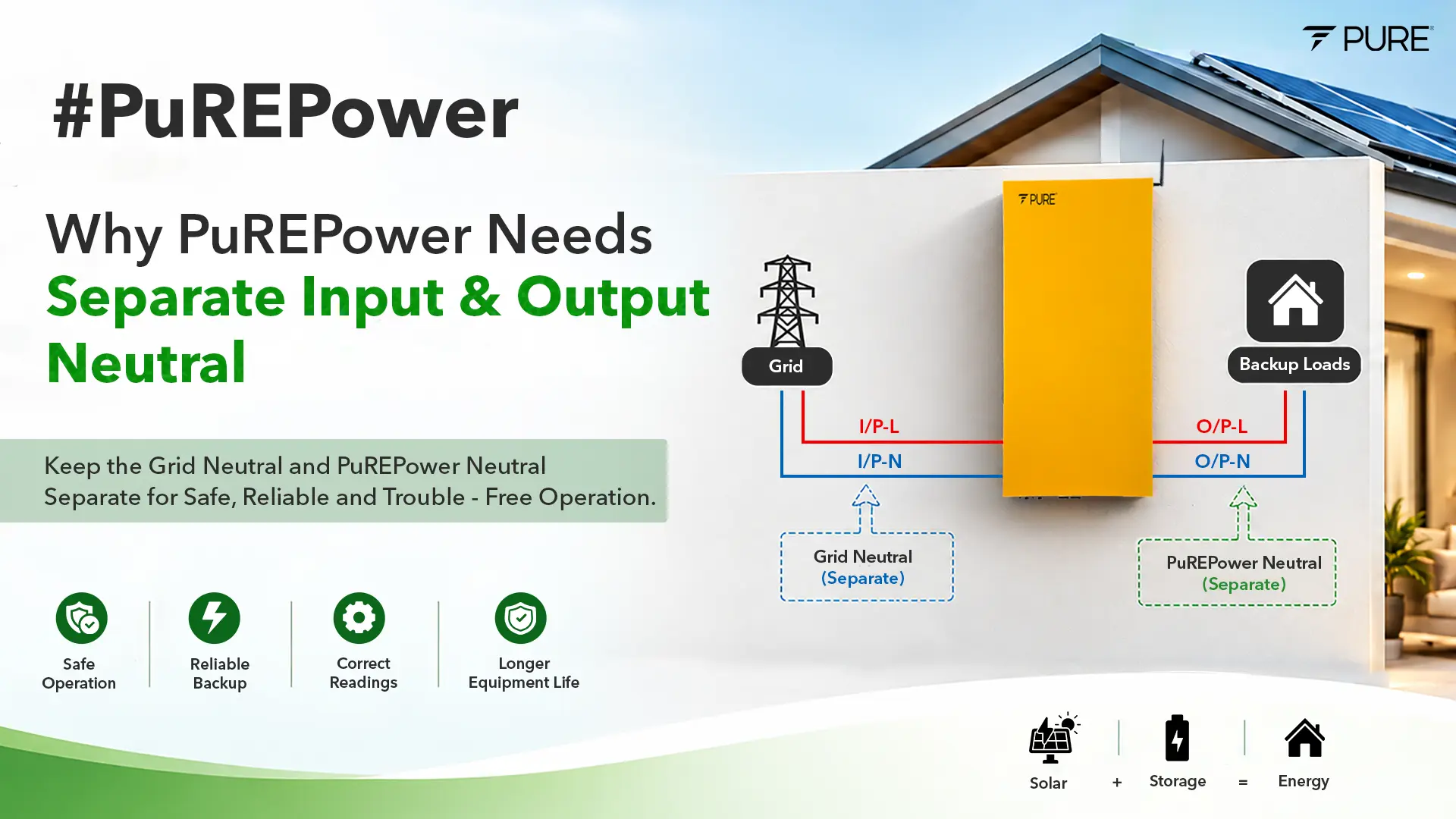
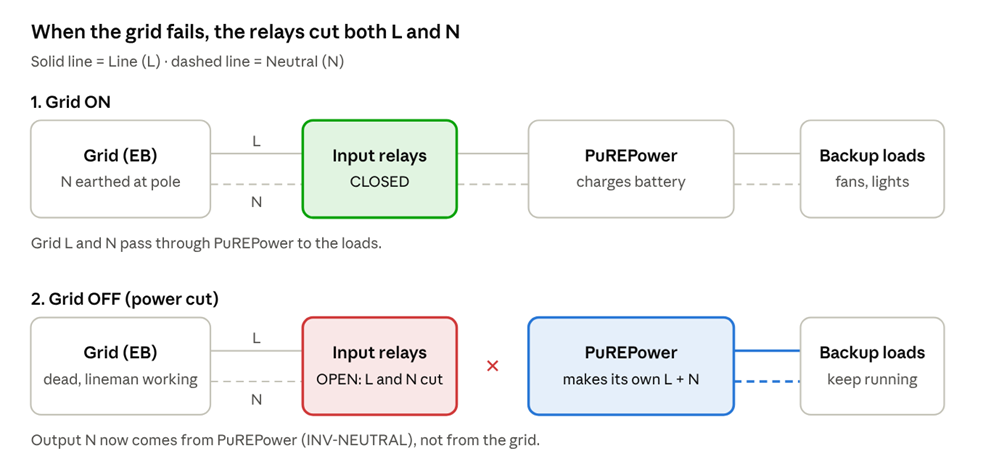
The grid neutral and PuREPower's neutral are two different wires from two different power sources. When the grid fails, PuREPower disconnects the grid's L and N with its relays and starts making its own power with its own neutral. If someone joins the input and output neutral outside PuREPower, that relay is bypassed. Two sources then share one wire, so breakers trip, readings go wrong, or PuREPower gets damaged.
In one line: input N belongs to the grid, output N belongs to PuREPower, so never join them. Explore PuREPower power backup system
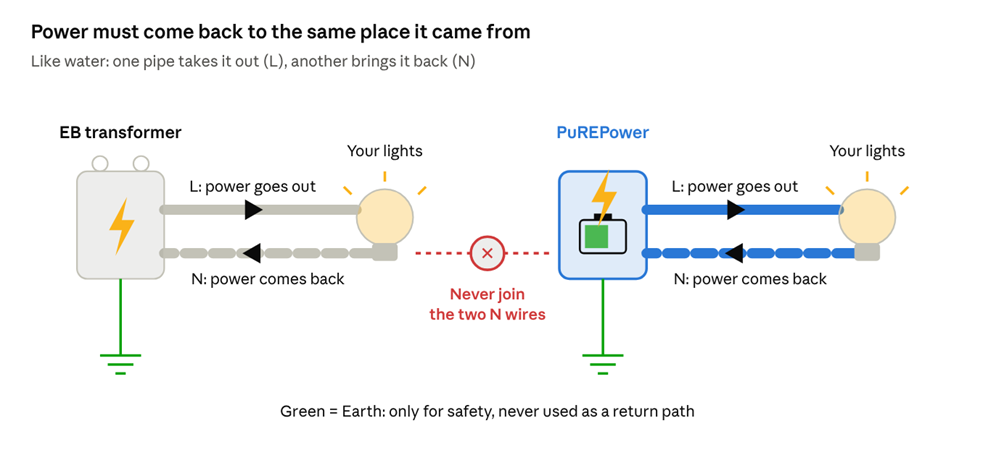
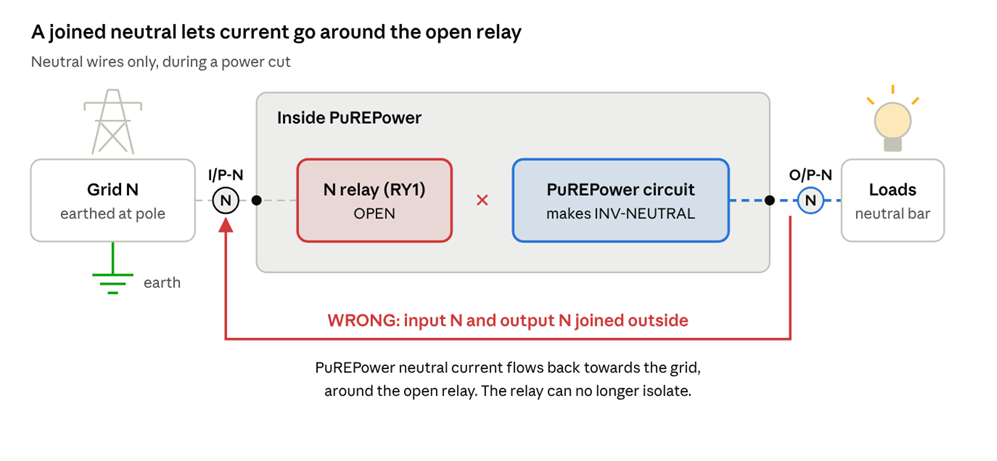
A relay can only isolate a wire if that wire has no other path.
An outside link between I/P-N and O/P-N is that other path.
1. The relay must cut the neutral too. During a power cut, PuREPower opens L and N to fully separate itself from the grid. A joined
neutral defeats this.
2. Lineman safety (anti-islanding). The grid must be
completely dead during a power cut. A shared neutral can carry PuREPower's
power back onto EB lines.
3. PuREPower's neutral is a working wire. The grid's neutral is tied to earth, so it stays near 0 V. During a power cut, PuREPower's neutral is not tied to earth. It is part of the circuit that makes the power, so it carries voltage. Joining the two neutrals creates a short circuit and can damage PuREPower.
Use two boards with two separate neutral bars: the grid feeds PuREPower, and PuREPower feeds the backup board.
1. EB power goes only into PuREPower's IN (I/P-L, I/P-N).
2. PuREPower's OUT (O/P-L, O/P-N) goes only to the backup board.
3. Each board has its own neutral bar.
4. No wire joins input N and output N, anywhere.
5. Earth (green wire) goes to the earth pit. Earth is never used as neutral.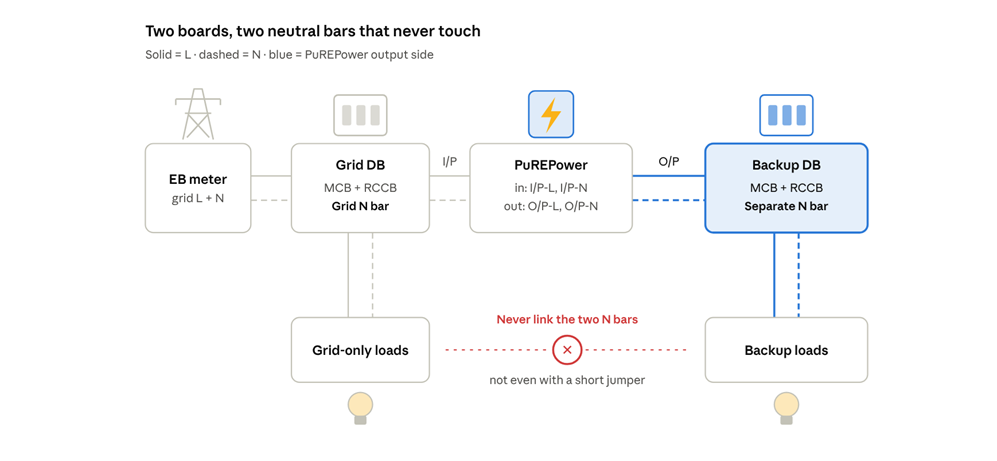
Ready to protect your home or business from power cuts? Discover the PuREPower range, or call us on +91 924 004 5993 to speak with our team.
Everything you need to know about this topic.


 Call Now
 PuREPower Dealership
 PuREPower Enquiry Now