

In the first half of 2025, something happened that most of us never expected to see in our working lives.
For the first time in history, the world generated more electricity from renewables than from coal.
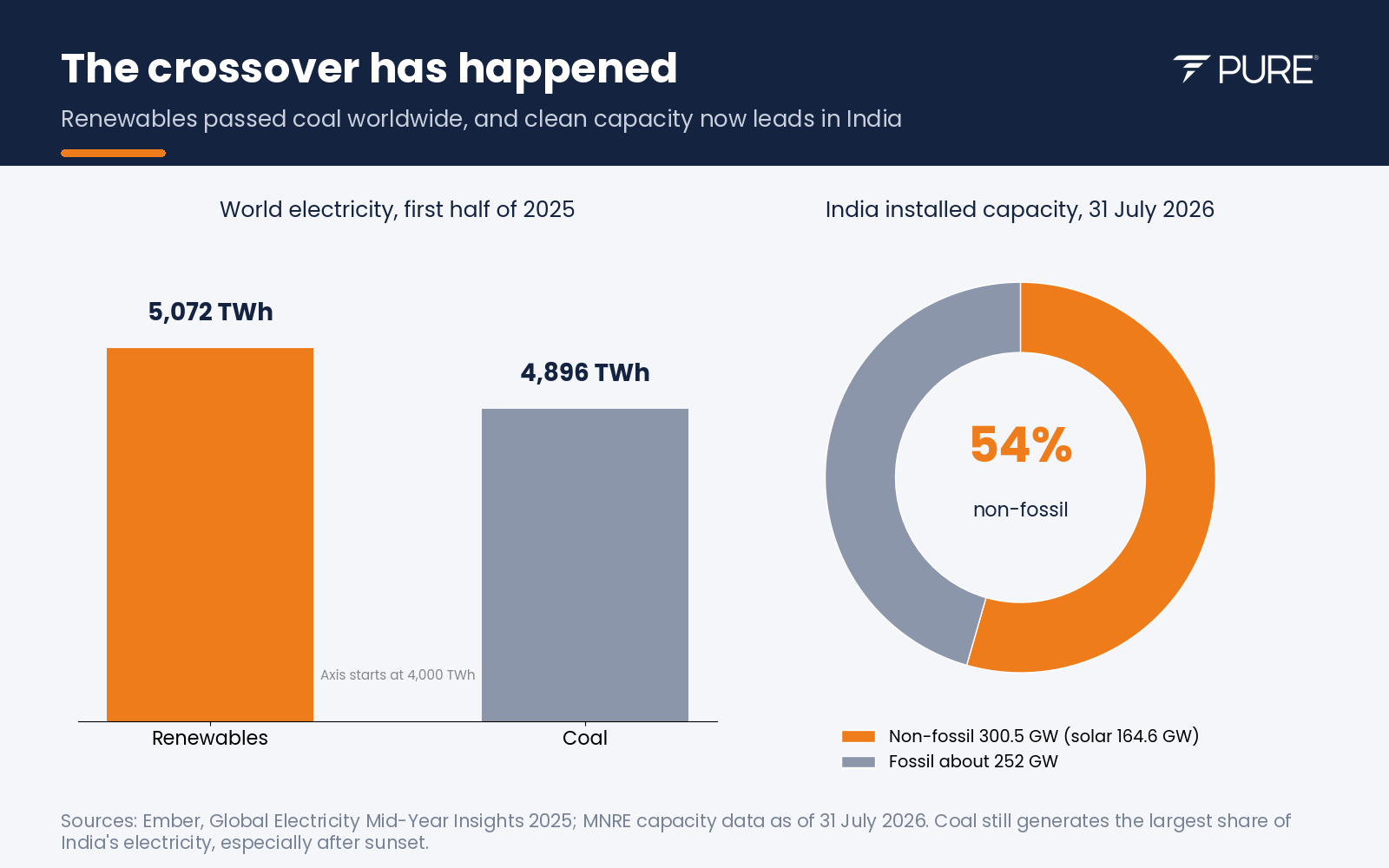
Not in one country. Across the planet. Ember, the energy think tank that tracks monthly power data from 88 countries, put the numbers side by side: about 5,072 TWh from renewables against about 4,896 TWh from coal. And two countries did most of the heavy lifting. China and India.
Here at home, the change is even more visible. As of 31 July 2026, India had 300.5 GW of non-fossil power capacity, more than 54% of everything installed in the country. Solar alone stands at about 165 GW. In 2014 it was under 3 GW.
That is a story to be proud of. But it is not the end of the story.
Because the sun sets every evening. And the moment it does, your building's power, your bill and your backup plan are back in the hands of an old system that is under more stress than ever.
This article explains, in plain English, what this shift really means for you, and why the most practical response for almost every Indian building is a battery.
QUICK ANSWER
India now has more clean capacity than fossil capacity, but solar only produces in daylight. The grid is short of power and flexibility in the evening, so evening electricity is getting more expensive through Time-of-Day tariffs, while midday solar is so abundant that some of it is wasted. A battery energy storage system lets your building store cheap daytime energy, use it at the expensive evening peak, ride through power cuts and voltage swings, and get far more value from rooftop solar. That is why battery storage is moving from a luxury to a basic building service.
For a hundred years, the logic of electricity was simple. Burn something, spin a turbine, send the power down a wire. Supply followed demand, because you could always burn a little more.
Solar breaks that logic. It does not follow your demand. It follows the sun.
On a clear afternoon, India's grid now has so much solar flowing in that operators have to push coal plants down to their minimum and, on some days, still cannot use all the solar on offer. The Centre for Research on Energy and Clean Air estimates that India curtailed about 1,462 million units of solar power in July and August 2026 alone. That is clean electricity that was available, paid for in capacity, and simply not used.
Then the sun sets. Lights, fans, air conditioners, kitchens, lifts and pumps all switch on as people come home. Solar disappears in about an hour. Something has to fill that gap, fast.
India set an all-time peak demand record of about 271 GW in May 2026. But the bigger story is not the height of the peak. It is how fast the grid has to climb to reach it.
Every evening, as solar fades, coal and gas plants have to ramp up to cover the gap. In May 2023, that evening climb was about 36 GW. By May 2026, it had roughly doubled to about 74 GW. That is like adding the power demand of several large states in the space of a few hours, every single day.
Engineers call the daily load shape that results the "duck curve": a deep dip at noon when solar floods in, and a steep neck in the evening when it disappears. Every grid that adds a lot of solar eventually meets this duck. India has met it now.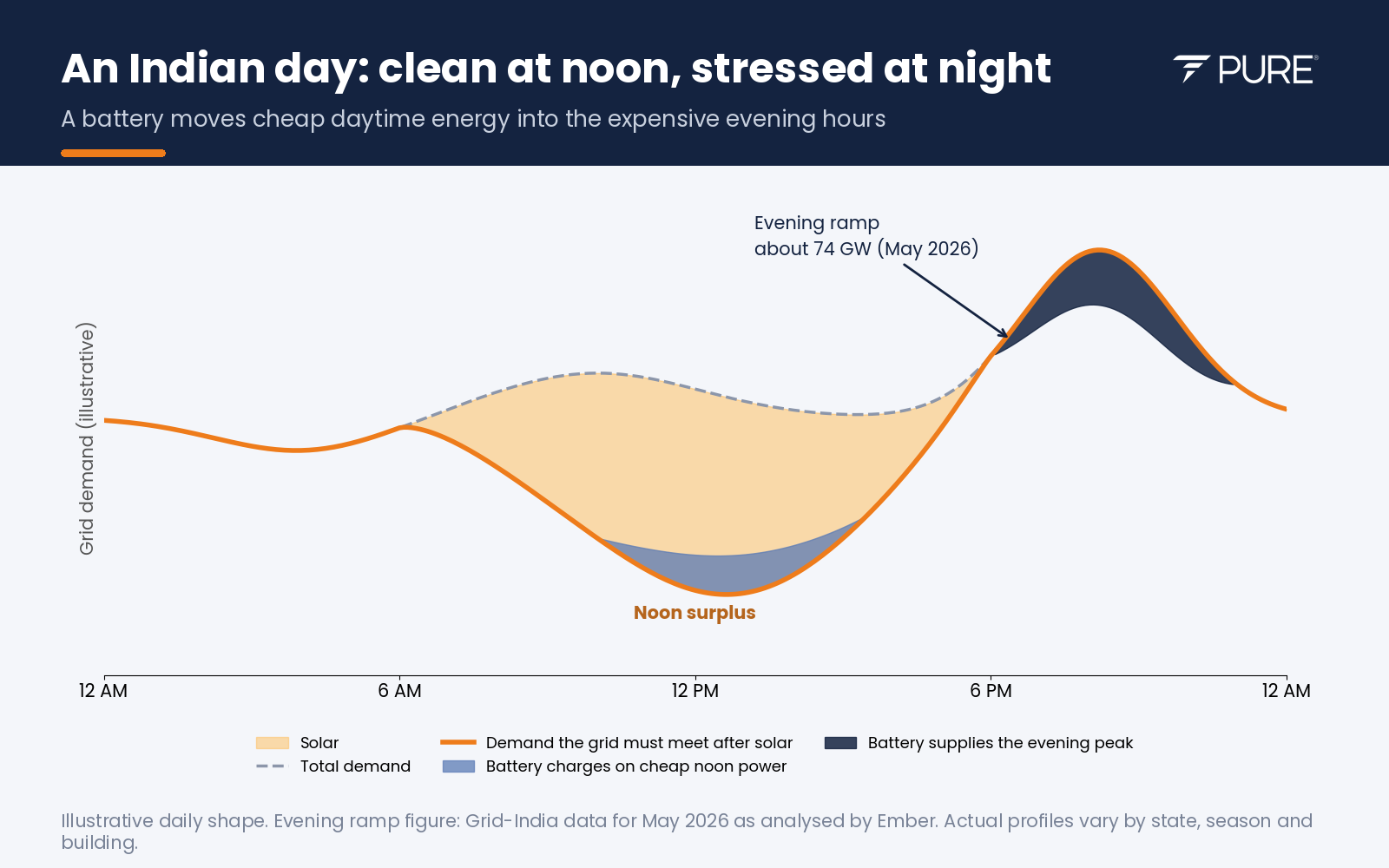
The think tank Ember estimated that around 10 GWh of battery storage, charged during peak solar hours, would have been enough to absorb the surplus India was wasting in early 2026. The Central Electricity Authority's National Electricity Plan goes much further, projecting that India needs about 236 GWh of battery storage by 2031-32. As of August 2026, only about 9 GWh was operational.
So India knows the answer. The grid needs storage. The question for you is simpler: what happens to your building while the grid catches up?
When power is scarce in the evening and abundant at noon, it is only logical that it should be priced that way. India has now written that into the rules.
Under the Electricity (Rights of Consumers) Amendment Rules, 2023, Time-of-Day (ToD) tariffs apply to commercial and industrial consumers with a maximum demand above 10 kW from April 2024, and are being extended to other consumers, except agriculture, as smart meters are rolled out. Under ToD, a unit at the evening peak costs more and a unit in solar hours costs less. In Telangana's FY 2026-27 tariff order, for example, peak hours carry a surcharge of ₹1.50 per unit, while solar hours earn a rebate of ₹0.50 per unit.
That ₹2 spread between noon and evening is the price signal for storage. A battery that charges in the solar hours and supplies your building in the evening captures it, every day, for years.
Rooftop solar is a brilliant investment, and schemes such as PM Surya Ghar have made it far more accessible. But a solar panel produces most of its energy between 10 AM and 4 PM, when many homes are empty and many offices are already in their low-cost hours.
Without storage, that energy is exported to the grid at noon and bought back at night. As ToD pricing spreads, the unit you sell at noon is worth less than the unit you buy at 8 PM. The gap grows with every new solar panel in your city. Storing your own solar for the evening is how you keep its full value.
A grid with lots of solar behaves differently. In residential areas with many rooftop systems, voltage can rise at noon. In the evening, as everyone switches on together, local transformers and feeders are stretched and voltage can sag. Add summer storms, maintenance shutdowns and load shedding in many districts, and the result is familiar to every Indian: flickering lights, tripping inverters, ACs that refuse to start and equipment that fails early.
A modern battery system with a pure sine wave inverter and fast switchover isolates your building from much of this. Your critical loads see clean, stable power, whatever the feeder is doing.
For decades, the answer to unreliable power was a diesel generator. Today, diesel is expensive, noisy and increasingly restricted. Emission norms for gensets have tightened, and cities such as Delhi restrict diesel generator use during poor air quality periods. Every litre burnt also puts a running cost on your backup that never goes away. We have shown the numbers in our PuREPower 60.0 vs diesel generator analysis.
A battery gives silent, instant, zero-emission backup, and earns money on the days the grid does not fail.
THE CORE INSIGHT
The energy transition has moved the scarcity in India's power system from fuel to time. Electricity is now cheap and clean at noon and expensive and stressed in the evening. The asset that moves energy across time is a battery, and the place it creates the most value is right where the power is used: inside your building.
India will build large grid batteries, and that is welcome. Tenders worth tens of GWh are already under way. But storage at the building level does things a grid battery never can.
Every building battery is also a small contribution to the national problem. Thousands of buildings that draw less at the evening peak make the duck curve a little flatter for everyone.
Battery storage is not one product. It is a family of systems sized to how a building actually uses power. As a simple guide:
| Building type | Typical need | What a battery does | PuREPower range |
|---|---|---|---|
| Homes, villas and apartments | Whole-home backup including ACs, solar storage | Silent backup, evening solar use, voltage protection | 3.0 Lite to 12.0 (single phase) |
| Shops, clinics, small offices | Business continuity, POS and refrigeration, AC | No downtime, lower evening cost, no diesel | 5.0 to 20.0 |
| Hospitals, schools, hotels | Critical loads, lifts, pumps, labs | Instant backup, ToD savings, cleaner campus | 30.0 to 120.0 (three phase) |
| Factories and commercial buildings | Demand charges, ToD, process continuity | Peak shaving, solar shifting, DG replacement | 60.0 and 120.0, combinable |
Every PuREPower system is an all-in-one unit: NMC battery, hybrid inverter, solar MPPT charge controller, AI-enabled battery management system and cloud monitoring in one factory-tested box. We size against the nominal rating, which is 75% of the maximum power, so the system runs cool and comfortable for its whole life.
The honest way to evaluate a building battery is not as a backup expense. It is as a small power plant that earns in several ways at once:
Not every building earns from all five. But most earn from at least three, and that is usually enough to make the numbers work well within the life of the system.
India has done something remarkable. It has built more clean power capacity than fossil capacity, and it did it faster than almost anyone predicted.
But clean power that arrives at noon does not run your building at 9 PM. The grid's new challenge is time, not fuel, and that challenge now shows up in your tariff, your voltage and your backup plan.
The good news is that the solution already exists, it is made in India, and it fits in your building. A battery that stores cheap daytime energy and gives it back when you need it most is no longer a luxury.
It is simply how a modern Indian building works.
Share your connected load and your last three electricity bills with us. A PuREPower advisor or your nearest authorised dealer will recommend the right battery system for your building and estimate your savings: www.pureenergy.co.in/enquiry-now
Everything you need to know about this topic.


 Call Now
 PuREPower Dealership
 PuREPower Enquiry Now